Complete guide to logo printing on food packaging for Saudi restaurants 2026 — printing technologies compared, Pantone color matching, file specifications, first-order costs with plate fees, and G-Pack logo printing services.
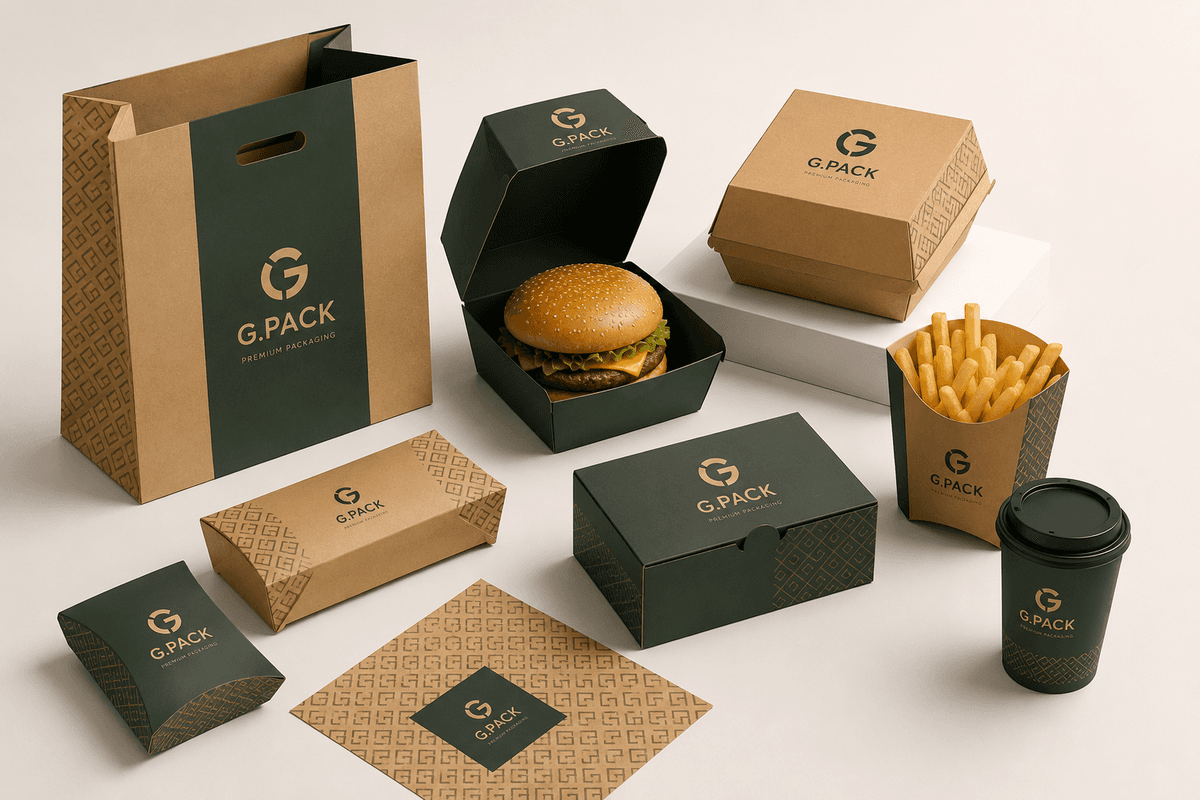
Logo printing on food packaging is more than a visual identity decision — it is a business investment with measurable return. Every item of packaging that carries a restaurant logo becomes a brand impression vehicle traveling from the kitchen to the customer and often beyond: into an office, home, car, or social media post. In Saudi Arabia, where dining culture is highly social and food photography is ubiquitous on Instagram and TikTok, logo-printed packaging generates organic brand reach that no paid advertising channel can replicate at equivalent cost. A plain cup costs SAR 0.33-0.48 per unit. A logo-printed cup costs SAR 0.43-0.62. The difference is SAR 0.10-0.14 per unit — and for that increment, every cup becomes a brand impression that extends brand reach throughout the eating and drinking experience. This guide covers the complete technical specification, printing technology options, pricing, and strategic framework for logo printing on Saudi restaurant packaging in 2026.
Logo Design for Packaging — Different Rules Apply. Logos designed for digital screens behave differently on printed packaging surfaces. The same logo file that looks sharp on an Instagram post may print poorly on a corrugated box or a paper cup. Key considerations for logo design in packaging contexts: Color behavior — screen colors (RGB) are more saturated than printable colors (CMYK or Pantone). A logo with highly saturated digital colors must be color-profiled for print. Always request a print proof before approving a volume run. Detail threshold — fine lines, small text, and intricate details that display clearly at 300 pixels on screen may fall below the resolution threshold for printing on textured materials like corrugated cardboard. Minimum recommended line weight for cardboard printing: 0.5mm. Minimum text size for readability on packaging: 6pt for cups, 8pt for corrugated surfaces. Bilingual Arabic-English logos — Saudi restaurant logos typically include both Arabic and Latin characters. Both scripts must have equivalent visual weight and size to communicate equal brand authority in both languages. Small Arabic text on corrugated surfaces is particularly vulnerable to print quality degradation — ensure Arabic text is above the minimum size threshold.
| Printing Method |
|---|

Complete guide to packaging printing methods for Saudi restaurants in 2026 — flexographic, offset, digital, and silkscreen explained with specifications, cost comparison, food safety requirements, and how to choose the right method for your volume and design.

Complete guide to wholesale packaging discounts for Saudi restaurants 2026 — annual contracts, volume discount tiers, multi-item consolidation, upfront payment discounts, Ramadan pre-order strategy, and G-Pack wholesale pricing.
| Resolution |
|---|
| Color Range |
|---|
| Min Order |
|---|
| Cost per Unit |
|---|
| Best For |
|---|
| Digital printing | High (1200 dpi) | Full CMYK | 500-1,000 units | Higher per unit | Short runs, prototypes, seasonal |
| Flexography (flexo) | Good (150-200 lpi) | Spot colors + CMYK | 3,000-5,000 units | Low at volume | High-volume cups, bags, corrugated |
| Offset lithography | Very high (175-200 lpi) | Full CMYK + Pantone | 2,000-5,000 units | Low at volume | Premium flat packaging |
| Screen printing | Good (85-120 lpi) | Spot colors (1-4) | 500-2,000 units | Medium | Fabric bags, specialty surfaces |
| Hot stamping / foil | N/A (metallic) | Metallic foils only | 1,000+ units | High | Premium accent on boxes |
| Embossing / debossing | N/A (texture) | No color | 1,000+ units | Medium-high | Premium unboxing effect on boxes |
Printing Technologies — When to Choose Each. Digital printing: the right choice for low-volume, high-flexibility requirements. No plate or setup fee. Full CMYK range. Best for prototypes and seasonal limited-edition packaging where a short run (500-2,000 units) is needed. Per-unit cost is higher than flexo at equivalent volume, but the zero setup fee makes it economical at low quantities. Flexography (flexo printing): the dominant technology for high-volume food packaging printing in Saudi Arabia. Low per-unit cost at 3,000 units and above. Plate setup fee: SAR 300-800 per color. Once plates are made, reorders have no setup fee. The right choice for cups, bags, and corrugated boxes at production volume. Offset lithography: highest print quality of any packaging printing method. Best for flat packaging items where the printing surface is smooth. Pantone color matching: for logos with specific brand colors (corporate identity colors), specifying a Pantone color ensures consistent color reproduction across all packaging items and all print runs.
| Specification | Cups (paper) | Corrugated Boxes | Paper Bags | Wax/Greaseproof Paper | Notes |
|---|---|---|---|---|---|
| Color mode | CMYK or Pantone | CMYK or Spot | CMYK or Pantone | CMYK | Pantone for brand color accuracy |
| Min line weight | 0.25mm | 0.5mm | 0.35mm | 0.25mm | Below minimum risks loss of detail |
| Min text size | 6pt | 8pt | 7pt | 6pt | Arabic text requires extra size for clarity |
| File format | AI or PDF (vector) | AI or PDF (vector) | AI or PDF (vector) | AI or PDF (vector) | Bitmap files not accepted for production |
| Resolution (if bitmap) | 300 dpi at print size | 150-200 dpi | 300 dpi | 300 dpi | Always prefer vector source files |
| Color profile | ISO Coated v2 | ISO Coated v2 | ISO Coated v2 | ISO Coated v2 | Proofing recommended for each surface |
Logo Color and Packaging Limitations. Many Saudi restaurant logos were designed for digital use only — social media, website, and menu board — where the full RGB color gamut is available. Translating these logos to print packaging involves understanding the color limitations of each substrate. Key color considerations: Kraft paper and cardboard are not white. Printing on kraft or unbleached corrugated produces different results than printing on white-coated paper. The brown substrate changes how colors appear: white ink does not exist in standard printing (except specialty spot white ink), so any white space in a logo becomes the substrate color (brown or unbleached kraft). Solution: request a substrate-accurate proof before production. Neon or fluorescent colors are outside the CMYK gamut and cannot be reproduced by standard food packaging printing. Use Pantone spot colors or color substitutes. Gold and silver effects require either metallic Pantone inks or hot stamping — CMYK cannot simulate metallic appearance accurately.
| Item | Plain Cost SAR | 1 Color Logo SAR | 2 Color Logo SAR | 4 Color CMYK SAR | Plate Setup (first order) |
|---|---|---|---|---|---|
| Cup 8oz | 1,650-2,400 | 2,150-3,100 | 2,800-3,800 | 3,700-5,000 | SAR 400-800 per color |
| Kraft bag medium | 2,750-4,000 | 3,600-5,100 | 4,600-6,400 | 6,250-8,500 | SAR 400-800 per color |
| Pizza box 30cm | 2,800-3,800 | 4,100-5,300 | 5,300-6,900 | 6,900-9,000 | SAR 600-1,200 per color |
| Corrugated delivery box | 4,500-7,000 | 6,000-9,000 | 7,750-11,500 | 10,500-15,500 | SAR 600-1,400 per color |
| Greaseproof wrap paper | 1,400-2,100 | 3,000-4,250 | 3,900-5,400 | 5,250-7,500 | SAR 400-800 per color |
The Golden Rule of Logo on Packaging
The minimum viable logo print on packaging is a single-color version of the logo. A 1-color logo print on a cup, bag, or box costs SAR 0.05-0.12 more per unit than plain — and transforms a generic packaging item into a branded one. Before deciding between 2-color, 4-color, or full CMYK print, confirm that a 1-color version of the logo produces a satisfactory brand impression. For many strong, well-designed logos, 1-color print at volume is the optimal balance of brand impact and unit economics. Full CMYK is not always better — for a bold, simple logo, it may add cost without proportional brand value.
Comparison of Logo Printing Technologies for Food Packaging. A practical reference for matching logo complexity and production volume to the right printing technology: Simple 1-2 color logo, high volume (5,000 plus units): flexo printing. Low per-unit cost, adequate quality for simple logos, fast production at volume. Full-color photography or complex gradient logo, any volume: digital printing (low volume) or offset lithography (high volume). Seasonal limited-edition packaging (500-2,000 units): digital printing. No plate fee, full CMYK, fast turnaround. Premium presentation packaging: offset with Pantone colors, hot stamping for metallic accents, or embossing for tactile premium effect. Eco-positioned packaging with logo: water-based inks on kraft paper substrates. The most important rule: always request a physical printed proof on the actual substrate before approving the production run. No digital simulation accurately represents the final printed result on corrugated cardboard, kraft paper, or a paper cup.
The logo file used for packaging must be finalized. Any logo changes after plates are made require new plate production at additional cost. Confirm the logo with all stakeholders and obtain written final approval before briefing any packaging supplier.
Convert all logo files to vector format (Adobe Illustrator AI or high-resolution PDF with embedded vector paths). Provide the logo in full color, single-color black, and single-color white versions. Specify all Pantone color numbers.
The economics of logo printing improve at higher volume due to amortized plate costs. Start logo printing on the item with the highest daily consumption (usually the cup or primary delivery bag). This delivers the most brand impressions per riyal of investment.
Before approving any production run, request a physical printed proof on the actual packaging material (not a digital simulation). Review the proof for: color accuracy, minimum line weight reproduction, text legibility, and overall brand impression.
Total first-order cost = (unit price x quantity) + plate setup fee per color. At 3,000 units with 2-color print, the plate fee (SAR 800-1,600 total) represents SAR 0.27-0.53 per unit. This plate cost drops to zero on all reorders.
Submit print-ready files and the final specification to G-Pack. Confirm quantity per item, print colors, material specification, size, and delivery address. Production timeline for flexo: 14-21 days. Digital: 7-14 days.
Plates are kept on file after the first order — reorders require only artwork confirmation and are faster and cheaper. Set a reorder trigger at 3-4 weeks of remaining stock to maintain continuous branded packaging.
After the first successful logo print run, evaluate adding logo print to the next highest-volume packaging item each quarter. Building out the complete branded packaging suite over 4-6 quarters is more manageable financially than attempting all items simultaneously.
Per-unit cost increment over plain packaging (at 3,000 units): cups 8oz SAR 0.10-0.17 per unit for 1-color, SAR 0.23-0.34 for 4-color. Kraft bags SAR 0.17-0.24 for 1-color. Pizza boxes SAR 0.26-0.35 for 1-color. First-order plate setup: SAR 400-800 per color for most items. Reorders: no plate fee. The most common Saudi restaurant starting point is 1-color or 2-color flexo on the primary cup or bag at 3,000 units.
Vector files only: Adobe Illustrator (.ai) or high-resolution PDF with embedded vector paths. Raster images (PNG, JPEG, BMP) are not acceptable for production-quality packaging printing regardless of resolution. If the logo was only created as a PNG or JPEG, it must be redrawn in vector format by a designer before it can be used for packaging production.
Yes — bilingual Arabic-English logos are standard in Saudi restaurant packaging. Arabic text requires larger minimum sizes than Latin text for equivalent print clarity on textured surfaces (minimum 8pt Arabic on corrugated vs 6pt Latin). Ensure the Arabic and English versions of the logo are given equal visual weight in the design — both languages represent equal customer groups.
Minimums vary by printing technology: digital printing from 500-1,000 units per item (no plate fee, higher per-unit cost). Flexo printing from 3,000-5,000 units per item (plate fee on first order, lower per-unit cost). Most Saudi restaurant operators place the first logo print order at 3,000 units — this balances plate fee amortization against storage requirements.
Specify Pantone (PMS) color numbers for all brand identity colors. Pantone provides standardized color matching across all printing environments and substrate types. Without Pantone specification, CMYK output varies between printers and substrates. Request a physical proof on the actual packaging substrate before production approval.
Yes — gradients are achievable with digital printing (full fidelity) and offset lithography (high fidelity). Flexo printing handles simple gradients but degrades complex gradient transitions. For logos with complex gradient effects, specify digital printing for low volumes or offset for high volumes. For flexo, request a printed gradient test on the actual substrate before committing to production.
Digital printing: 7-14 days production plus 1-3 days delivery. Flexo first order with plate production: 14-21 days production plus 1-3 days delivery. Flexo reorders (plates already produced): 10-14 days plus 1-3 days delivery. Total timeline planning: 4-6 weeks from artwork submission to receipt for a first flexo order.
New plate production is required, which triggers the full plate setup fee for each changed color. Minor adjustments may allow plate modification at reduced cost. Complete redesigns require full new plate production. This is why finalizing the logo before the first packaging order is critical — late-stage logo changes are expensive to implement on printed packaging.
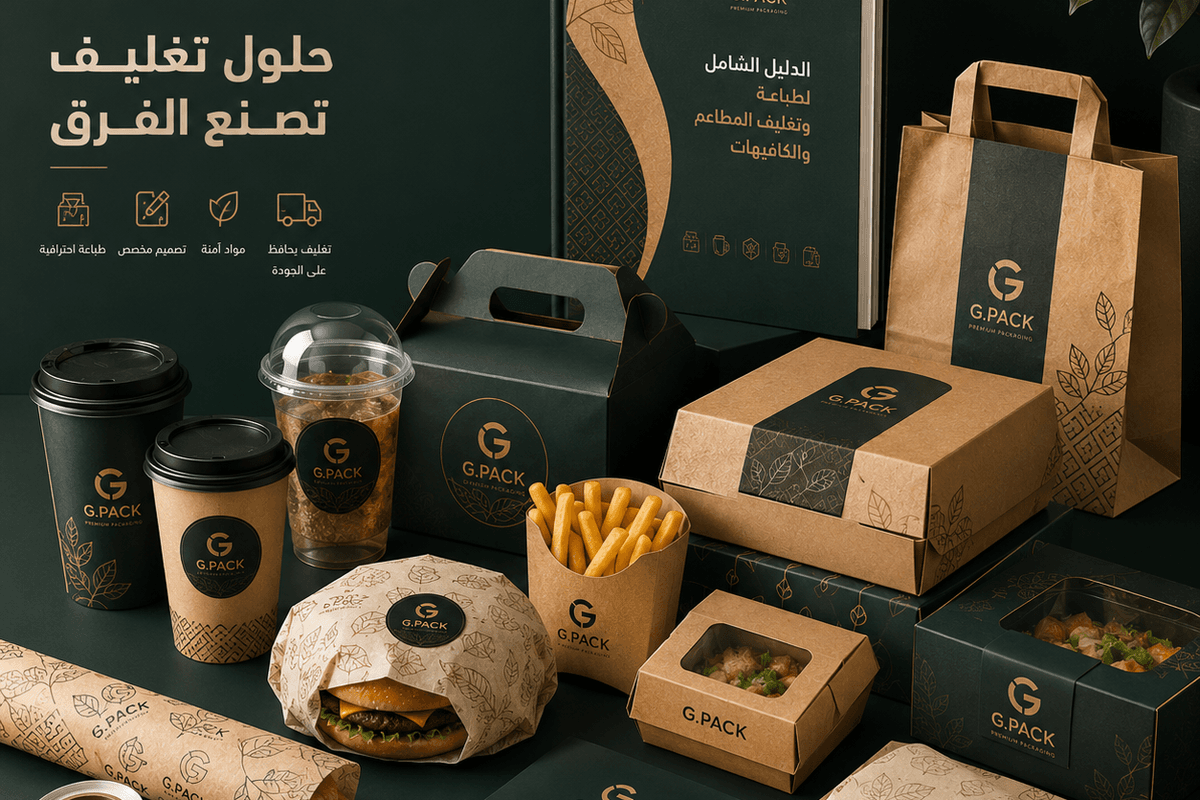
G-Pack provides full logo printing services for Saudi restaurant packaging — cups, bags, boxes, and wrap paper. Vector file review, Pantone color matching, physical proofs before production, and flexo from 3,000 units. Get a free quote.
Get a Free Quote