A comprehensive professional guide to printing single wall and double wall paper cups in Saudi Arabia — differences, materials, printing techniques, sizes, pricing, and how to choose the perfect cup for your brand.
Printing paper cups — whether single wall or double wall — is not just about putting a logo on a cup.
In the Saudi market of 2026, your branded paper cup is your brand ambassador that reaches your customer's hand with every coffee, tea, or hot beverage order.
This complete guide is written by the G-Pack expert team — Saudi Arabia's leading food packaging manufacturing and printing company — to cover everything you need to know about printing paper cups: from the technical differences between single wall and double wall, to printing techniques, sizes, materials, sustainability, and everything that affects your purchasing decision.
Who Is This Guide For?
This guide is for every cafe owner, restaurant manager, hotel procurement officer, and catering company in the Kingdom of Saudi Arabia. Whether you're launching a new brand or upgrading your visual identity — this guide provides all the technical and commercial information to make the right decision.
Printed paper cups are cups made from food-grade paper coated with an inner layer that prevents liquid leakage, with your logo, design, or brand colors printed on the exterior using food-safe inks.
Paper cups consist of three essential elements:
The outer paper — the visible surface that carries your logo and design, typically made from kraft or high-quality white paper weighing 190-350 g/m².
The inner coating — a thin layer of polyethylene (PE) or polylactic acid (PLA) that prevents liquid leakage and maintains beverage quality.
The exterior print — your logo and brand colors printed with food-safe inks using offset or flexographic printing in CMYK or Pantone color systems.
In the Saudi market, printed paper cups have become the gold standard for cafes, restaurants, and food establishments that offer delivery or takeout services, because they combine the function of holding beverages with smart marketing.

Complete guide to wholesale packaging discounts for Saudi restaurants 2026 — annual contracts, volume discount tiers, multi-item consolidation, upfront payment discounts, Ramadan pre-order strategy, and G-Pack wholesale pricing.

Complete guide to measuring and maximizing custom packaging ROI for Saudi restaurants 2026 — social media amplification, delivery rating improvement, cost-per-impression vs digital advertising, and ROI calculation framework.
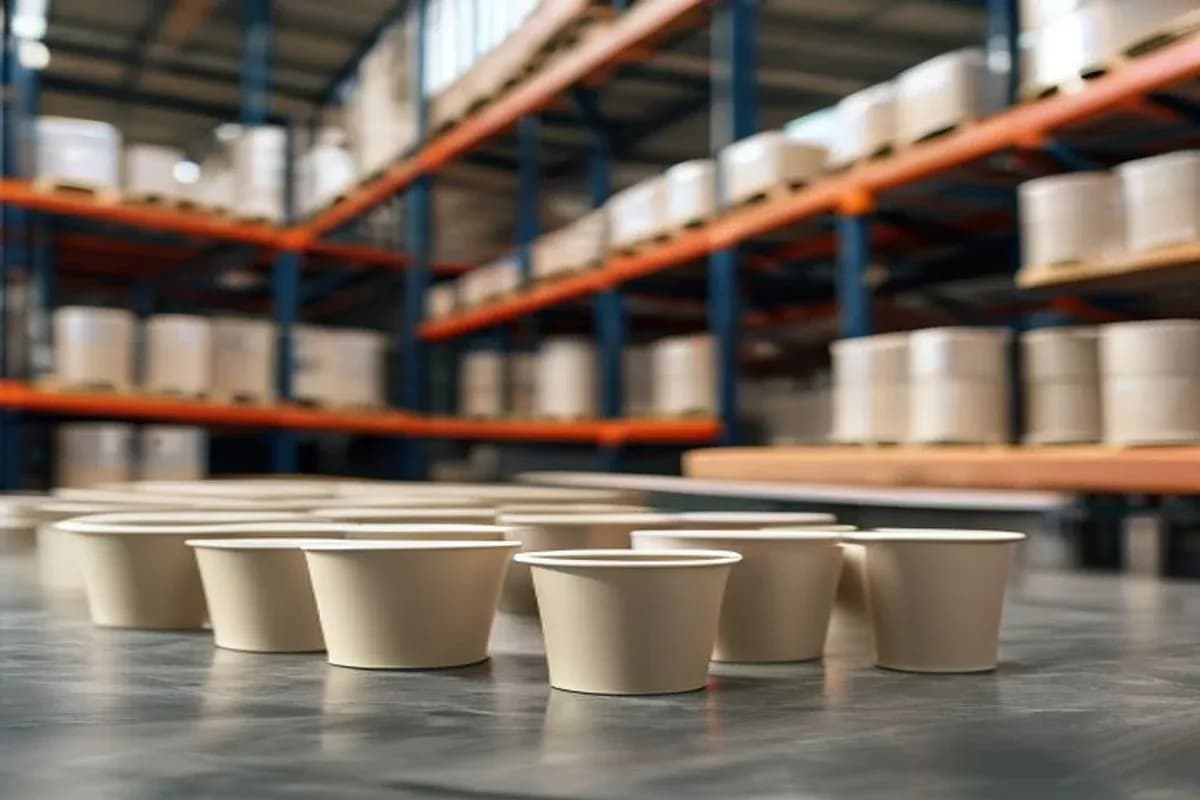
Single wall cups consist of a single layer of paperboard coated with an inner PE or PLA layer. They are the economical, lighter, and lower-cost option, ideal for cold beverages and hot drinks served with a paper sleeve.
Single wall advantages:
25-35% lower cost than double wall — ideal for budget-conscious operations and high volumes
Lighter weight for easier storage and transport
Suitable for cold drinks, juices, and water
Accepts full CMYK color printing on the exterior surface
Available in all sizes from 4 oz to 22 oz
Double wall cups consist of two layers of paper with an air gap between them that acts as a natural thermal insulator. This smart design keeps beverages hot longer and protects the customer's hand from heat without needing an additional sleeve.
Double wall advantages:
40% better thermal insulation than single wall — beverages stay hot longer
Hand protection from heat — no additional sleeve needed = cost savings
More premium, thicker appearance that reflects brand quality
Ideal for hot beverages: coffee, cappuccino, latte, tea, soup
Accepts full CMYK color printing on the exterior surface
Ripple wall cups are the latest evolution in paper cup technology. They consist of three layers: inner paper, corrugated middle layer, and printed outer paper. They provide the highest level of thermal insulation and a distinctive premium appearance.
Ripple wall is the ideal choice for premium cafes and luxury hotels that want to deliver an exceptional customer experience.
| Criteria | Single Wall | Double Wall | Ripple Wall |
|---|---|---|---|
| Layers | 1 layer | 2 layers + air gap | 3 layers + corrugated |
| Thermal Insulation | Low | High (40% better) | Highest (70% better) |
| Hand Heat Protection | Needs sleeve | Safe to hold | Fully safe |
| Relative Price | Lowest | Medium (+25-35%) | Highest (+50-70%) |
| Ideal Use | Cold / warm | Hot | Very hot / premium |
| Weight | Lightest | Medium | Heaviest |
| Appearance | Simple | Premium | Ultra-premium |
| Printing | Full CMYK | Full CMYK | Full CMYK |
| Sustainability | Recyclable | Recyclable | Recyclable |
| MOQ | 1,000 | 1,000 | 1,000 |
Understanding the manufacturing process helps you appreciate product quality and make a more informed purchasing decision. Paper cups go through six main stages:
Manufacturing begins with selecting FDA-approved, SFI-certified, FSC-certified food-grade paper. Paper weight ranges from 190-350 g/m² depending on cup type — single wall uses lighter paper, double wall uses heavier paper for both layers.
Printing is done on flat paper before cup forming. This ensures higher print quality because printing on a flat surface is more precise than printing on a curved surface. Offset or flexographic techniques are used with food-safe inks.
After printing, the paper sheet is coated with a thin layer of polyethylene (PE) or polylactic acid (PLA) using extrusion coating. This layer is what prevents liquid leakage.
The printed and coated paper sheet is cut into an open fan shape using precision dies. It is then folded to form the cup wall.
The sheet is formed on a cup forming machine that transforms it into the final cup shape. The sides are heat-sealed and the cup base is securely attached. For double wall cups, the second layer is added at this stage.
Cups are automatically inspected for seal quality and leak prevention. They are then packed in cartons of 500-1,000 cups each with adequate protection for transport.
The paper used in manufacturing paper cups must be food-grade — meaning it is FDA-approved for direct contact with food and beverages. This paper is free from harmful chemicals, heavy metals, and dangerous bleaching agents.
Polyethylene is the most common coating for paper cups. A very thin PE layer (15-20 microns) provides excellent leak and moisture resistance. It withstands temperatures from -40 to +100 degrees Celsius. The only drawback of PE is that it is not biodegradable — but it is recyclable in specialized facilities.
PLA is the sustainable alternative to PE. Derived from plant starch (corn, sugarcane), it is biodegradable under industrial conditions within 90-180 days. It resists leaks but is less tolerant of high temperatures — suitable for cold and warm beverages. PLA cups cost 0.05-0.10 SAR more than PE cups but offer a genuine sustainability advantage.
Warning: Beware of Non-Certified Cups
In the Saudi market, there are cheap imported cups without FDA or SFI certifications. These cups may use non-food-grade paper, toxic inks, or poor-quality coating. Always use cups from a trusted manufacturer like G-Pack that provides quality and safety certifications for every production batch.
Paper cup printing is done before cup forming — on flat paper — to ensure the highest print quality. There are two main techniques:
Offset printing is the most common and precise technique for paper cup printing. It uses aluminum plates to transfer the image to a rubber cylinder and then to the paper. It delivers exceptional print quality at 150-200 lines per inch (LPI).
Offset advantages:
High color accuracy — 98% Pantone color matching
Suitable for complex designs and fine details
Higher setup cost but lower unit cost at large volumes
FDA-approved food-safe inks
Ideal for quantities of 5,000+ cups
Flexo printing uses flexible rubber plates to transfer ink directly to the paper. It is faster than offset and has lower setup costs, but print quality is slightly lower.
Flexo advantages:
Lower setup cost — suitable for small quantities (1,000-5,000)
Higher production speed
Good quality for simple designs (logo + text)
Food-safe inks
CMYK (Cyan, Magenta, Yellow, Black) is the standard four-color printing system. It can produce virtually any color from four primary colors. Suitable for most designs and offers a wide color gamut.
Pantone is a globally standardized color system. Each Pantone color has a specific reference number that ensures exact matching between print and design. Used by brands that require absolute color accuracy (like corporate logo colors).
At G-Pack, we offer both options: CMYK for standard designs and Pantone for brands that require absolute color accuracy.
Printed paper cups are available in a wide range of sizes to cover all restaurant and cafe needs:
| Size | Volume (ml) | Ideal Use | Beverage Type |
|---|---|---|---|
| 4 oz | 120 ml | Espresso, coffee shot | Hot |
| 6 oz | 180 ml | Espresso lungo, small tea | Hot |
| 8 oz | 240 ml | Cappuccino, Turkish coffee, tea | Hot |
| 10 oz | 300 ml | Flat white, small latte | Hot |
| 12 oz | 360 ml | Latte, mocha, Americano | Hot / Cold |
| 16 oz | 480 ml | Large coffee, iced latte, juice | Cold / Hot |
| 20 oz | 600 ml | Large beverages, smoothies | Cold |
| 22 oz | 650 ml | Family drinks, water | Cold |
G-Pack Expert Tip
Don't order more than 3-4 sizes for your restaurant. Each additional size means a separate MOQ, separate storage, and higher management costs. Most successful cafes use only 3 sizes: 8oz for small, 12oz for medium, 16oz for large.
Printed paper cups serve a wide range of sectors in the Saudi market:
Cafes are the primary users of printed paper cups. Every cup that leaves the cafe is a mobile advertisement — reaching your customer's office, home, and car. Specialty cafes prefer double wall for espresso and cappuccino because the thermal insulation maintains the ideal coffee temperature (65-70 degrees Celsius) longer.
Restaurants offering delivery need leak-proof cups with transparent PET/PS lids. Double wall is the ideal choice for delivery because it maintains beverage temperature during the delivery trip (20-45 minutes) and prevents leakage.
Luxury hotels use ripple wall or double wall cups printed with the hotel logo for room service, events, and conferences. The premium appearance and excellent thermal insulation reflect the level of premium service.
Events, conferences, and exhibitions use paper cups printed with the event or sponsor logo. Single wall is economical for large-scale events with high volumes, while double wall adds a premium touch for upscale events.
Bakeries and dessert shops use small cups (4-8 oz) for serving coffee and tea with desserts. Printing with the shop logo reinforces visual identity and reminds customers of the brand with every visit.
Catering companies and airlines need large quantities of printed paper cups with company branding. Quality, food safety, and print consistency are critical criteria in this sector.
Choosing the right cup depends on five key factors:
If 70%+ of your beverages are hot, choose double wall. If they are cold or warm, single wall is sufficient and economical.
Single wall: 0.07-0.30 SAR. Double wall: 0.10-0.45 SAR. Ripple wall: 0.15-0.60 SAR. Calculate cost per serving, not per individual cup.
Don't order more than 3-4 sizes. Most cafes use 8oz + 12oz + 16oz. Each additional size means a separate MOQ and separate storage.
CMYK for standard designs (cheaper). Pantone for brands requiring absolute color accuracy (+10-15% cost).
PE for hot beverages (most common and economical). PLA for cold beverages (eco-friendly and biodegradable).
G-Pack offers a free digital mockup within 24 hours and an actual production sample before full production begins. Never order large quantities without seeing a sample first.
Your branded paper cup is the most powerful silent marketing tool in your restaurant. Every cup that goes out is a mobile advertisement reaching places your digital ads cannot.
Practical example: A cafe sells 150 cups of coffee daily. The difference between a plain cup and a branded cup = 0.15 SAR. Additional daily cost = 22.5 SAR (675 SAR monthly). In return, 150 cups daily = 4,500 mobile advertisements monthly. Cost per advertisement = 0.15 SAR — there is no cheaper advertising medium with this level of reach.
Clear, large logo — visible from 1-2 meters away
Two primary colors — avoid cluttered designs with too many details
Consistent typography matching your visual identity
Contact information (WhatsApp, Instagram) on the back panel
Short, impactful message (e.g., "Freshly roasted daily")
Colors that contrast with the beverage color for visual distinction
As Saudi Arabia moves toward a green economy under Vision 2030, sustainability in packaging has become a genuine competitive advantage, not just an ethical choice.
PE cups (polyethylene): Recyclable in specialized facilities but not biodegradable. Lower cost, higher durability, most common.
PLA cups (polylactic acid): Biodegradable under industrial conditions within 90-180 days. Derived from renewable plant starch. Costs 0.05-0.10 SAR more per cup.
70% of Saudi consumers aged 18-35 prefer dealing with brands that care about sustainability. Offering PLA cups or unbleached kraft paper sends a strong message to environmentally conscious customers and enables premium pricing of 5-10%.
The Kingdom is gradually moving toward reducing single-use plastics. Restaurants and cafes that start transitioning now toward sustainable paper cups will find themselves in a comfortable position when any future regulatory measures are implemented.
A cup that is 0.05 SAR cheaper but leaks or burns the hand costs you a negative review worth dozens of customers. Saving at the expense of customer experience is the worst economic decision.
A restaurant serving different beverage sizes but using one cup has to overfill or underfill. At least three sizes are the minimum for serious cafes.
A sample reveals printing issues, material quality, color accuracy, and seal quality before it's too late. G-Pack offers a free sample and digital mockup — never skip this step.
Paper cups are damaged by moisture (above 60%), extreme heat (above 35 degrees), and pressure. Store them in a dry, cool place away from the kitchen and steam.
A cup is not a canvas — it is a marketing tool. Clear logo + two colors + short message = perfect design. Cluttered designs weaken the message and are hard to read from a distance.
Before ordering printed paper cups, use this checklist as a comprehensive reference:
The price of a printed paper cup is affected by six main factors:
| Factor | Price Impact | Change Range |
|---|---|---|
| Wall Type | Single cheaper than double | 25-35% difference |
| Size | Larger size = higher price | 0.07-0.60 SAR |
| Quantity (MOQ) | Higher volume = lower unit price | Up to 45% savings at 10K |
| Print Type | CMYK cheaper than Pantone | 10-15% difference |
| Coating Type | PE cheaper than PLA | 0.05-0.10 SAR/cup |
| Design | Simple design cheaper than complex | Depends on colors |
These prices are approximate and depend on quantity and specifications. For an exact quote, contact G-Pack.
| Product | 1,000 cups | 5,000 cups | 10,000 cups | Savings at 10K |
|---|---|---|---|---|
| Single Wall 8oz | 0.30 SAR | 0.20 SAR | 0.18 SAR | 40% |
| Single Wall 12oz | 0.35 SAR | 0.25 SAR | 0.22 SAR | 37% |
| Double Wall 8oz | 0.44 SAR | 0.36 SAR | 0.30 SAR | 32% |
| Double Wall 12oz | 0.50 SAR | 0.40 SAR | 0.34 SAR | 32% |
| Double Wall 16oz | 0.60 SAR | 0.48 SAR | 0.40 SAR | 33% |
Single wall cups have one layer — lighter and 25-35% cheaper, ideal for cold and warm beverages. Double wall cups have two layers with an air gap that provides 40% better thermal insulation and protects hands from heat without needing an additional sleeve.
The MOQ at G-Pack is 1,000 cups. You can mix sizes (e.g., 500 8oz + 500 12oz) in the same order to meet the minimum. Larger quantities (5,000+) receive discounts up to 40%.
Yes, we use offset CMYK printing with four primary colors that can produce any desired color at high quality. For brands requiring absolute color accuracy, we offer the Pantone matching system with globally standardized colors.
Yes, absolutely. Cups are made from FDA-approved food-grade paper, and the inner PE coating withstands temperatures up to 100 degrees Celsius. The inks used are food-safe and non-toxic. Double wall is the best choice for very hot beverages.
Production takes 7-14 working days after design approval, plus 1-3 days for delivery. During Ramadan, the timeline may extend to 21 days — so we recommend ordering 6-8 weeks before the holy month begins.
Yes, G-Pack offers a free digital mockup within 24 hours for your approval before production begins. We also provide an actual production sample for large orders before full production to ensure your complete satisfaction with quality and colors.
Yes, kraft paper cups are made from natural wood pulp and are recyclable. PE cups are recyclable in specialized facilities. For a more sustainable option, we offer PLA-coated cups with polylactic acid from plant starch that is biodegradable within 90-180 days.
PE (polyethylene) is the most common and economical coating — withstands high temperatures and efficiently prevents leakage. PLA (polylactic acid) is derived from plant starch and is biodegradable — eco-friendly but less tolerant of high temperatures and costs 0.05-0.10 SAR more per cup.
Yes, with a printed paper sleeve to protect hands from heat. The inner PE coating prevents leakage. However, if 70%+ of your beverages are hot, double wall is the better economic choice as it eliminates the need for additional sleeves.
Store them in a dry place (humidity below 60%), cool (under 35 degrees), away from excessive pressure and humid areas like the kitchen. Do not stack cartons more than 4-5 layers high. Follow the FIFO system — first in, first out — and label each carton with the receipt date.
We recommend 3 sizes: 8oz for espresso and small cappuccino, 12oz for latte, mocha, and Americano, 16oz for cold drinks and iced latte. These three cover 95% of a typical cafe's needs without additional storage costs.
Yes, G-Pack offers free design and digital mockup within 24 hours. Send us your logo file in AI or PDF format and the desired size, and we will prepare a digital mockup for your approval before production begins.
Get a free quote and free design within 24 hours. Single wall, double wall, all sizes, CMYK/Pantone printing, FDA certified, and fast delivery to all regions of the Kingdom.
Get a Free Quote