Complete packaging budget guide for Saudi restaurants 2026 — per-order cost calculation, budget benchmarks by restaurant type, seasonal planning, waste reduction, and annual contract negotiation with G-Pack.
Restaurant packaging budgeting is one of the most neglected cost categories in Saudi food service operations — and that neglect is expensive. Most restaurant operators know their food cost percentage, their labor cost percentage, and their rent as a proportion of revenue. Few know their packaging cost as a percentage of revenue, their per-order packaging cost across their full menu, or what their annual packaging budget should be by restaurant type and size. This guide provides the complete framework for building, tracking, and optimizing a restaurant packaging budget for Saudi operations in 2026 — with benchmarks, pricing data, budget templates by restaurant type, and cost control strategies specific to the Saudi market.
Who This Guide Is For
This guide is for Saudi restaurant owners, F&B managers, purchasing managers, and financial controllers who are responsible for packaging costs. Whether opening a new restaurant and building a packaging budget from zero, or auditing an existing operation for packaging cost optimization, this guide provides the framework and benchmarks needed.
The first step in building a correct packaging budget is calculating the true cost of packaging per order — not just the cost of the primary food container, but the total cost of all packaging items that leave the kitchen with each transaction. Full per-order packaging cost includes: the primary food container or box, the inner wrap or lining if used, the paper bag or delivery bag, the cup and lid, the cup sleeve if used, napkins, condiment cups and lids, cutlery set, stickers and seals, and any specialized packaging such as sauce cups or dessert containers. Most Saudi restaurants that calculate this correctly discover their actual per-order packaging cost is 15-35% higher than their estimate. For a full-service Saudi restaurant averaging SAR 55 per check, the full per-order packaging cost typically ranges from SAR 1.10-3.20 depending on packaging specification and whether delivery packaging is included.

Complete guide to wholesale packaging discounts for Saudi restaurants 2026 — annual contracts, volume discount tiers, multi-item consolidation, upfront payment discounts, Ramadan pre-order strategy, and G-Pack wholesale pricing.

Complete guide to measuring and maximizing custom packaging ROI for Saudi restaurants 2026 — social media amplification, delivery rating improvement, cost-per-impression vs digital advertising, and ROI calculation framework.
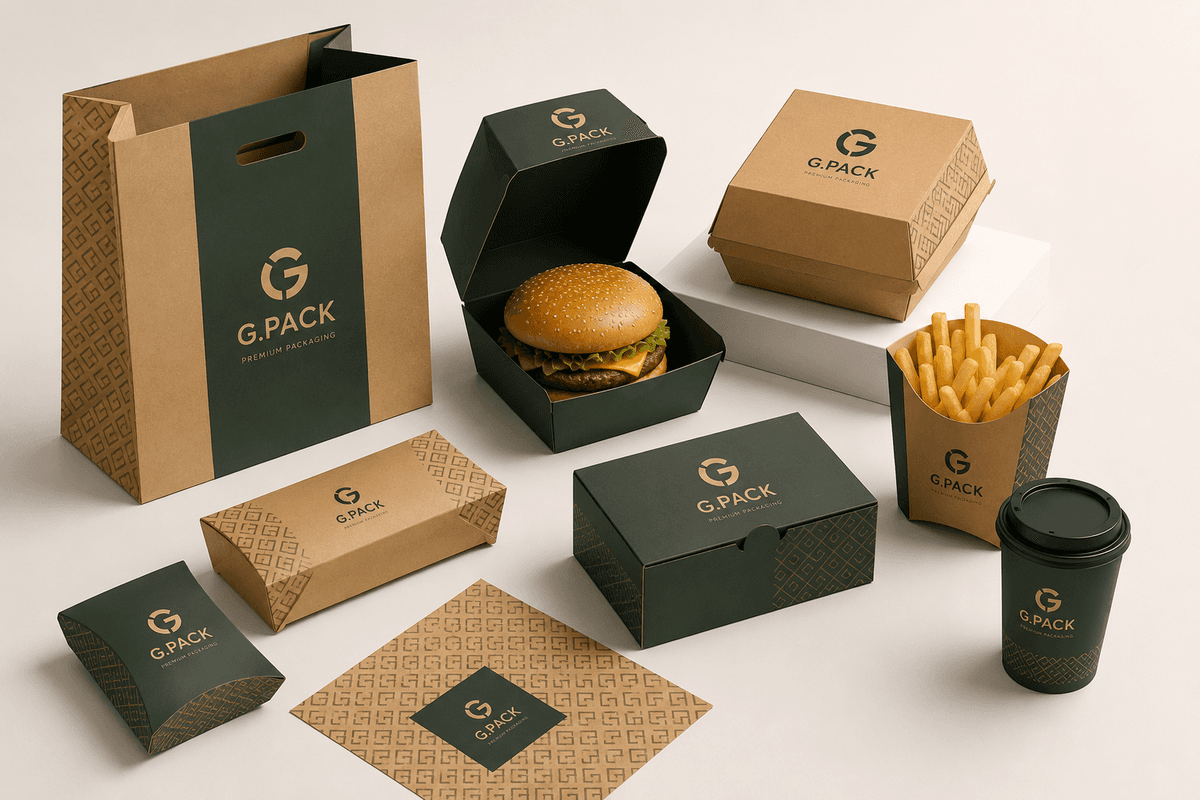
Categorizing packaging into tiers allows intelligent budget management by separating high-visibility brand packaging from functional internal packaging. Tier 1 — Brand packaging (customer-facing): everything the customer sees, holds, photographs, and carries out. Cups, primary food boxes, delivery bags, wrap paper. Investment level: custom printed, highest quality specification. This tier is a marketing investment, not just a cost. Tier 2 — Functional packaging (customer-facing but lower visibility): lids, cup sleeves, napkins, condiment cups, stickers. Investment level: standard quality, optional branding where cost-effective. Tier 3 — Internal packaging (invisible to customer): kitchen prep wraps, storage containers, internal transport packaging. Investment level: lowest cost specification that meets functional requirements. This tiered approach ensures that the brand investment is concentrated where it creates the most customer impact, while cost optimization is applied where the customer does not see the result.
| Restaurant Type | Monthly Packaging Budget SAR | Per-Order Packaging Cost SAR | Annual Budget SAR | Packaging as % of Revenue | Notes |
|---|---|---|---|---|---|
| Kiosk or cart (50 orders/day) | 1,200-2,200 | 0.80-1.45 | 14,400-26,400 | 1.5-3.0% | Cups and simple bags primary cost |
| Small cafe (80 orders/day) | 2,400-4,800 | 1.00-2.00 | 28,800-57,600 | 2.0-3.5% | Cups, lids, sleeves main items |
| Mid-size fast casual (150 orders/day) | 4,500-9,000 | 1.00-2.00 | 54,000-108,000 | 1.8-3.0% | Boxes, bags, cups full range |
| Full-service restaurant (200 orders/day) | 6,500-14,000 | 1.08-2.33 | 78,000-168,000 | 1.5-2.8% | Full packaging suite with delivery |
| Cloud kitchen / delivery (300 orders/day) | 9,000-21,000 | 1.00-2.33 | 108,000-252,000 | 2.0-4.0% | Delivery packaging dominant cost |
| Multi-branch chain (1,000 orders/day) | 24,000-60,000 | 0.80-2.00 | 288,000-720,000 | 1.2-2.5% | Volume economies reduce per-unit cost |
Purchase timing is one of the strongest tools for managing a packaging budget. The Saudi packaging market has identifiable pricing patterns: Pre-Ramadan (February-March): high demand period as restaurants stock for Ramadan season. Suppliers are at full capacity — prices are at annual highs and delivery lead times are extended. Order Ramadan packaging in November-December at normal-season pricing to avoid this premium. Post-Ramadan (May-June): demand drops sharply. Some suppliers offer promotional pricing on remaining seasonal stock. Strategic buyers take advantage of post-Ramadan pricing for non-seasonal items. Year-end Q4 (October-November): some suppliers offer year-end clearing prices on standard items. This is the best window for building up buffer stock on high-volume standard items at favorable pricing. Summer months (June-August): lower demand period for some categories. Standard cup and bag pricing is stable and supply is readily available.
Packaging prices in the Saudi market are influenced by external indices that packaging managers should monitor. The two most important external factors: pulp and paper commodity prices — the global price of wood pulp directly influences the production cost of paper cups, kraft bags, corrugated boxes, and all paper-based packaging. When global pulp prices spike (as they did in 2022), paper packaging prices in Saudi Arabia follow within 60-90 days. Monitor monthly pulp price indices to anticipate pricing changes before they arrive. Petroleum and petrochemical prices — the price of PE, PET, PP, and other petroleum-derived packaging materials is directly linked to the oil price. Saudi Arabia is an oil-producing country, but the packaging material market is global — international price shifts affect Saudi packaging costs. An oil price spike creates packaging cost pressure across all PE-lined cups, PET containers, and PE-based bags. Building a 6-8 week buffer stock during low-price periods insulates a restaurant operation from the worst of commodity-driven pricing volatility.
Comparing the annual packaging budget against industry benchmarks reveals whether packaging costs are in line with peer operations or represent an optimization opportunity. Saudi restaurant packaging cost benchmarks for 2026: packaging as a percentage of food revenue: 1.5-2.5% for dine-in focused operations, 2.5-4.0% for delivery-focused operations, 1.8-3.2% for mixed operations. Per-order packaging cost benchmarks: SAR 0.80-1.20 for kiosk and simple cafe formats, SAR 1.00-1.80 for standard fast casual, SAR 1.50-2.50 for delivery operations with branded packaging, SAR 2.00-3.50 for premium restaurants with full packaging suites. If packaging cost is above the upper benchmark for the restaurant type, the primary causes are typically: ordering below MOQ (paying above-volume pricing), not using volume consolidation across items, carrying excessive buffer stock that ties up working capital, or using over-specified packaging for low-visibility items.
| Packaging Category | % of Budget | Monthly SAR (at SAR 7,000 budget) | Key Items | Optimization Priority |
|---|---|---|---|---|
| Hot beverage packaging | 18-25% | 1,260-1,750 | Cups, lids, sleeves | High — high volume, print opportunity |
| Cold beverage packaging | 10-16% | 700-1,120 | Cold cups, lids, seals | Medium |
| Food containers and boxes | 25-35% | 1,750-2,450 | Boxes, trays, bowls | High — largest single cost |
| Bags (delivery and dine-in) | 12-18% | 840-1,260 | Kraft bags, delivery bags | Medium-High |
| Wrap paper and liners | 5-8% | 350-560 | Sandwich wrap, greaseproof | Low |
| Napkins and condiment cups | 4-7% | 280-490 | Napkins, sauce cups | Low — bulk pricing applies |
| Specialty and seasonal | 3-8% | 210-560 | Ramadan packaging, seasonal | Planned budget allocation |
Seasonal packaging costs deserve a separate budget line. Ramadan, Eid Al-Fitr, Eid Al-Adha, Saudi National Day, and Founding Day are the key occasions for Saudi restaurant seasonal packaging. For most Saudi restaurants, Ramadan alone requires a dedicated packaging budget allocation for: custom printed Ramadan-edition cups or boxes (typically 4-6 weeks volume), special packaging for iftar set menus, higher overall order volume (1.5-3x normal daily volume requiring proportionally higher packaging inventory). The budget planning approach: estimate Ramadan packaging costs at 2x the normal monthly packaging budget (combining the volume increase and the seasonal design premium). Allocate this additional budget 3-4 months before Ramadan to allow time for design, production, and advance ordering.
Tracking packaging waste and shrinkage in inventory improves the budget without reducing quality standards. The most common sources of packaging waste in Saudi restaurants: over-ordering (ordering quantities that exceed consumption before expiry or design changes, leading to disposal of excess stock), staff misuse (taking more packaging per order than the standard specification), incorrect packaging selection (using larger boxes than necessary for an item, inflating per-order cost), and storage damage (corrugated boxes and paper cups degrade in humid or heat-exposed storage, creating unusable stock). A practical waste tracking protocol: monthly physical count of all packaging items against usage records, variance flagging for any item with more than 5% shrinkage, and a quarterly packaging usage standard review. Most Saudi restaurants can reduce packaging cost by 8-15% through waste and misuse reduction without changing any packaging specification.
Packaging Prices 2026 — Budget Reference for Saudi Restaurants. The core packaging items and price ranges for 2026 budget planning: Paper cups: SAR 0.33-1.00 per unit depending on size, construction, and print. Kraft bags medium: SAR 0.55-1.28 per unit depending on size and print. Food boxes (corrugated): SAR 0.90-2.90 per unit depending on size and print. Pizza boxes (30cm): SAR 0.56-1.80 per unit depending on print spec. Sandwich wrap paper: SAR 0.03-0.18 per unit depending on size and print. Napkins: SAR 0.06-0.18 per unit. Sauce cups (small, 60ml): SAR 0.08-0.18 per unit. Cutlery sets (fork, knife, spoon): SAR 0.08-0.22 per set. Cup sleeves: SAR 0.13-0.34 per unit. At a standard Saudi restaurant doing 150 orders per day with mixed dine-in and delivery, the annual packaging cost at these prices ranges from SAR 54,000-108,000 — representing approximately 2-3% of annual food service revenue at typical Saudi market pricing.
| Item | Plain SAR | 1 Color Print SAR | 2 Color Print SAR | Notes |
|---|---|---|---|---|
| Cup 8oz (hot, single-wall) | 0.33-0.48 | 0.43-0.62 | 0.56-0.76 | Double-wall adds 35-45% |
| Kraft bag (medium) | 0.55-0.80 | 0.72-1.02 | 0.92-1.28 | Size varies price significantly |
| Food box (corrugated) | 0.90-1.40 | 1.20-1.75 | 1.55-2.15 | Custom size adds 10-20% |
| Pizza box (30cm) | 0.56-0.76 | 0.82-1.06 | 1.06-1.38 | First order needs plate fee |
| Sauce cup (60ml) + lid | 0.08-0.14 | N/A | N/A | Bulk pricing from 5,000 units |
| Napkin (standard) | 0.06-0.10 | 0.09-0.14 | 0.12-0.18 | 2,000 unit minimum |
| Cup sleeve | 0.13-0.22 | 0.18-0.28 | 0.23-0.34 | Alternative to double-wall cup |
| Cutlery set (3-piece) | 0.08-0.18 | N/A | N/A | Per-set pricing, bulk discount |
List every packaging item used per order for your three most common order types (dine-in, takeaway, delivery). Price each item at current unit cost. Sum for each order type. This is your baseline per-order packaging cost — compare it against the Saudi industry benchmark.
Multiply per-order packaging cost by daily order volume by 365. Add 15% for waste, seasonal demand spikes, and new item introduction. This is your annual packaging budget baseline. Compare against the industry benchmark percentage of revenue.
Assign every packaging item to Tier 1 (brand/customer-facing high-visibility), Tier 2 (functional/customer-facing), or Tier 3 (internal). Apply your highest budget allocation and print specification to Tier 1. Apply cost optimization to Tier 3. This prioritization maximizes brand investment efficiency.
Order all packaging items from the fewest possible suppliers in the largest practical order runs. Consolidation reduces per-unit cost through volume pricing, reduces administrative overhead, and simplifies inventory management.
Build Ramadan and National Day packaging budget allocations into the annual plan. Estimate Ramadan at 2x normal monthly packaging budget. Commission seasonal designs 10-12 weeks before each occasion and place orders 8 weeks before.
Count every packaging item weekly. Set reorder triggers at 3-4 weeks of remaining stock per item. Track actual vs. standard consumption monthly and investigate variances above 5%.
For the 3-5 packaging items with the highest annual volume, negotiate an annual supply contract with G-Pack. Annual contracts typically deliver 8-15% pricing improvement over spot-buy pricing on the same items.
Each quarter, compare actual packaging spend against budget by item category. Identify items with above-budget spending. Investigate causes (waste, price increase, volume spike) and implement corrective action.
10 Common Packaging Budget Mistakes to Avoid
(1) Not including all packaging items in the per-order cost calculation — napkins, sauce cups, and sleeves are invisible individually but significant in aggregate. (2) Ordering below MOQ because of cash flow constraints — below-MOQ premiums can add 20-40% to per-unit cost. (3) No seasonal budget reserve — running out of Ramadan packaging mid-season is a brand crisis. (4) Not tracking packaging waste — 8-15% of packaging cost can be eliminated through waste reduction. (5) Using over-specified packaging for back-of-house items (full corrugated boxes for internal kitchen storage). (6) Ordering all items at the same time regardless of consumption rate — items with different consumption rates need different reorder triggers. (7) No annual contract for high-volume items — paying spot-buy pricing on 300-unit-per-day items wastes SAR 15,000-40,000 per year. (8) Not benchmarking packaging cost against industry standards — without a benchmark, cost optimization has no reference point. (9) Changing packaging specifications frequently — each change resets pricing and may require new tooling or plates. (10) Not separating packaging cost from food cost in accounting — packaging must be tracked as a separate cost center for meaningful management.
Industry benchmark for 2026: SAR 0.80-1.20 per order for kiosk and simple cafe formats, SAR 1.00-1.80 for standard fast casual, SAR 1.50-2.50 for delivery operations with branded packaging, SAR 2.00-3.50 for premium restaurants with full packaging suites. If per-order packaging cost significantly exceeds these benchmarks for the restaurant type, the most common causes are below-MOQ ordering, over-specification on low-visibility items, or high packaging waste.
Saudi restaurant packaging cost benchmarks for 2026: 1.5-2.5% of food revenue for dine-in focused operations, 2.5-4.0% for delivery-focused operations, 1.8-3.2% for mixed operations. Operations below the lower benchmark may be under-investing in packaging quality (which has brand consequences). Operations above the upper benchmark have a cost optimization opportunity.
Step 1: List every packaging item for every order type. Step 2: Get pricing from G-Pack for each item at your estimated annual volume. Step 3: Calculate per-order cost for dine-in, takeaway, and delivery. Step 4: Multiply by estimated daily order volume by 365. Step 5: Add 15-20% buffer for waste and seasonal variation. Step 6: Cross-check against industry benchmark percentages of revenue. This process typically takes 2-4 hours for a new restaurant with a clear menu concept.
Ramadan typically increases packaging costs by 50-200% above normal monthly packaging costs, driven by two factors: (1) order volume increase of 1.5-3x normal daily volume, and (2) seasonal Ramadan edition packaging design and production costs. Budget planning approach: estimate total Ramadan packaging cost at 2x normal monthly budget. Order 8-10 weeks before Ramadan to avoid premium pricing and supply shortages.
The four highest-impact cost reduction strategies without quality compromise: (1) consolidate all packaging orders with one supplier to maximize volume pricing, (2) negotiate an annual contract on the 3-5 highest-volume items, (3) implement a packaging waste tracking system to eliminate the 8-15% waste that most Saudi restaurants have, (4) right-size packaging to menu items — ensure the correct box or container size is used for each item rather than defaulting to the largest available size.
Packaging is a semi-variable cost: the per-unit cost is fixed for a given order volume and contract, but the total monthly cost varies with order volume. For budgeting purposes, calculate a per-order packaging cost and multiply by projected monthly order volume. Track actual per-order cost monthly and investigate when it deviates from the standard — deviation typically signals waste, ordering below MOQ, or a pricing change.
Compare on a total cost of ownership basis, not just unit price: (1) unit price at the volume you actually order (not the volume that achieves the best price), (2) minimum order quantity vs. your actual order frequency, (3) delivery lead time and reliability, (4) sample and proof quality, (5) print quality for branded items. A supplier with a lower unit price but higher MOQ may cost more annually if the MOQ forces you to carry excess stock.
The items with the most optimization potential in most Saudi restaurant operations: (1) food containers and boxes (25-35% of the packaging budget — specifications are often above what is needed for internal kitchen items), (2) cups (high volume — even SAR 0.05 per unit savings multiplied by 100 cups per day = SAR 1,825 per year), (3) bags (often ordered at below-MOQ pricing due to multiple size SKUs — consolidation can reduce cost 15-25%). The items with the least optimization potential: napkins and sauce cups (already commodity-priced, volume is the only lever).
Total monthly packaging spend (all items) divided by total monthly food revenue, expressed as a percentage. Example: monthly packaging spend SAR 7,200 divided by monthly food revenue SAR 300,000 = 2.4%. Track this monthly and compare against the Saudi benchmark for your restaurant type (1.5-4% depending on format).
Yes — packaging prices are negotiable based on volume commitment, payment terms, and contract length. The most effective negotiation levers: (1) annual volume commitment — a commitment to purchase your full annual volume of a specific item delivers 8-15% pricing improvement, (2) multi-item consolidation — consolidating 5-8 packaging items with G-Pack delivers consolidation pricing, (3) advance payment terms — paying 30-50% upfront on a large order typically delivers an additional 3-5% price improvement. Contact G-Pack directly to discuss your volume and negotiate a framework agreement.
G-Pack provides free packaging cost consultations for Saudi restaurant operators — pricing across your full item list, annual contract pricing, volume consolidation analysis, and seasonal budget planning support.
Get a Free Quote