The complete guide to custom printed paper cups for Saudi cafes and restaurants in 2026 — cup types, printing methods, design rules, pricing across quantity tiers, ROI analysis, sustainability options, and the 10 most expensive ordering mistakes to avoid.
The custom printed paper cup is the most powerful and most underused marketing tool a Saudi cafe or restaurant can own. When your customer carries your cup down a busy street, places it on their office desk during a meeting, or photographs it before their first sip — your brand reaches places no paid advertisement can reach. The Saudi beverage and food service market is experiencing exceptional growth: over 8,000 cafes operate in the Kingdom in 2026, with annual sector growth exceeding 15%. For every cafe owner who has printed custom cups — or is seriously considering it — this guide covers the complete picture: the differences between cup wall types and why it matters for printing quality and customer experience, the main printing methods and which is right for your volume and budget, design rules that no design school teaches but every owner learns the hard way after an expensive wrong first run, real pricing across different quantities, and how to place your first order without making the mistakes that cost thousands of riyals and weeks of delay.
Who Is This Guide For?
This guide is written for the cafe or restaurant owner who wants to understand the complete purchasing decision before committing — whether ordering custom cups for the first time or evaluating whether to switch suppliers. It covers everything from technical printing specifications to ROI calculations, with no prior printing or packaging industry knowledge required.
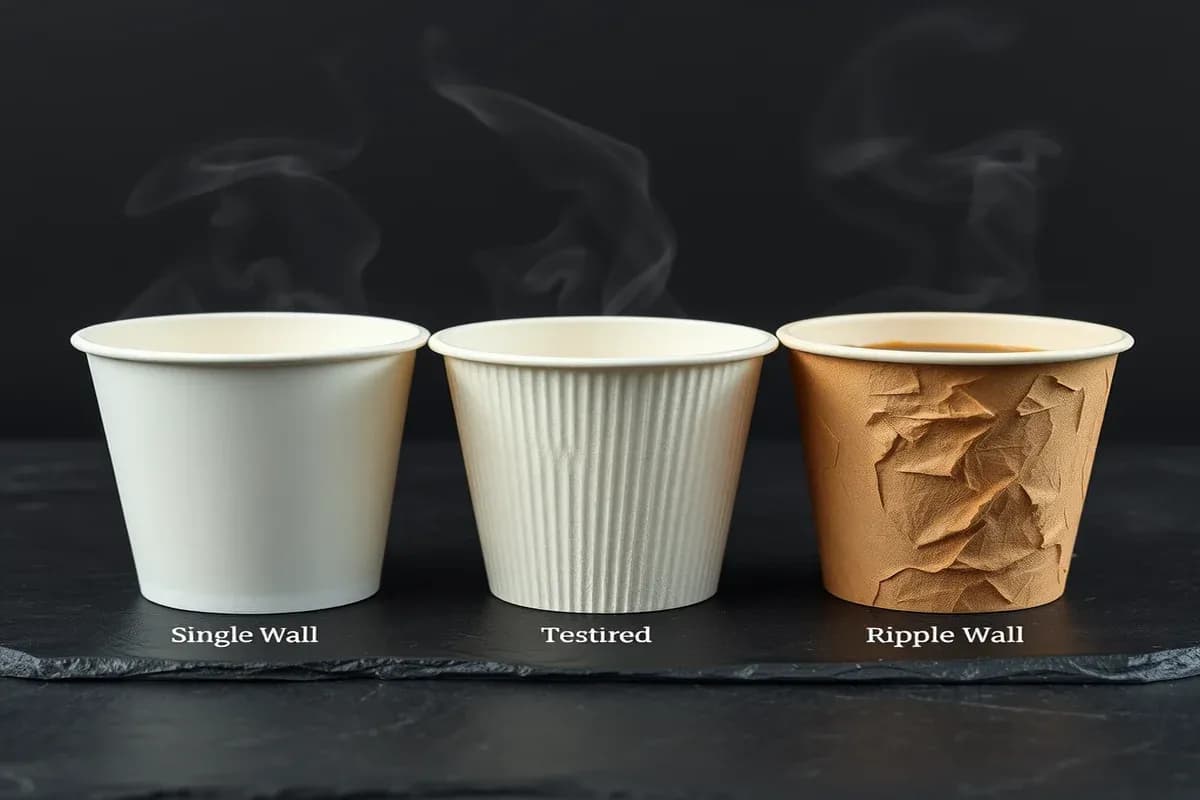
Types of Paper Cups — Not All Equal. The first decision before placing any order is selecting the right cup type for your use case. Single-wall cups: one layer of paper — the most economical option. Burns hands when holding hot drinks above 60°C for more than 90-120 seconds. Suitable only for cold beverages or when served with a paper sleeve, which adds cost and service time. Not recommended as a primary cafe hot beverage cup. Double-wall cups: two paper layers with an air pocket between them creating thermal insulation. The professional cafe standard for all hot beverages. A customer can hold a 70°C latte comfortably for the entire conversation without burning their hand. Flexographically printed double-wall cups are the most common custom printed cup in Saudi Arabia. Ripple-wall cups: the outer paper has a corrugated wave pattern that provides excellent grip, superior insulation, and a premium tactile quality. Adds 30-40% to cost versus double-wall. Ideal for high-end and specialty positioning. PLA-lined cups: any wall type can use PLA — a plant-based bioplastic lining — instead of standard PE lining. Makes the cup fully compostable. Adds approximately 20% to unit cost but communicates a genuine sustainability commitment that matters to the growing Saudi specialty coffee customer segment.

Complete paper cup sizes guide for Saudi cafes and restaurants 2026 — oz to mL conversion, hot vs cold cup differences, double-wall specifications, printing costs, and how to order the right cup for every menu item.

The definitive comparison of single-wall, double-wall, and ripple-wall paper cups for Saudi cafes in 2026 — heat insulation, custom printing, true cost analysis, and exactly which type to choose for your specific menu and brand positioning.
| Cup Type | Best Applications | Heat Insulation | Custom Printability | Price Range (SAR/cup) |
|---|---|---|---|---|
| Single Wall | Cold beverages, paper sleeve use only | Low | Good — flat outer surface | 0.30–0.50 |
| Double Wall | All hot beverages — professional standard | High ★★★★ | Excellent | 0.55–0.90 |
| Ripple Wall | Premium hot drinks, luxury brand positioning | Very High ★★★★★ | Limited outer texture | 0.75–1.15 |
| PLA-Lined (any type) | Eco-conscious brand — any hot or cold | Same as base type | Same as base type | +20% vs PE-lined |
Printing Methods — The Difference Between Average and Exceptional. The printing method determines not only cost per cup but the maximum quality achievable, the minimum order quantity required, and your production lead time. Flexographic printing: uses engraved plate rollers to transfer ink directly to the cup surface. The most cost-effective method for sustained high-volume orders. Produces vivid, consistent colors across runs of thousands of cups with excellent batch-to-batch consistency. Plate engraving cost of SAR 800-2,000 is a one-time setup fee amortized across the run — free on all future reorders with the same design. Minimum quantity: 2,000-3,000 cups. Lead time: 14-21 days. Digital printing: modern inkjet printing directly to cup surface — no plates, no minimum setup fees. Can reproduce full-color photographs, complex gradients, and detailed illustrations. Zero plate fees. Minimum quantity: 500 cups. Lead time: 5-10 days. The most accessible, lowest-risk entry point for new cafes or seasonal design changes. Silkscreen printing: used for adding special-effect inks — metallics, fluorescents, UV-reactive — on top of a flexo-printed base. Used to create premium finishes like gold or silver logo accents on an otherwise standard cup. Hot stamping: applies metallic foil under heat and pressure to create reflective gold or silver elements — used exclusively for luxury brand positioning.
| Method | Min. Quantity | Lead Time | Color Range | Best Application | Cost Level |
|---|---|---|---|---|---|
| Digital Printing | 500 cups | 5-10 days | Full color, gradients, photos | New cafes, seasonal limited designs | Medium per cup |
| Flexo Printing | 2,000-3,000 cups | 14-21 days | 1-4 solid colors | Main brand — established cafes, high volume | Lowest per cup |
| Silkscreen | 1,000 cups | 10-15 days | 1-2 metallic or special effect | Premium logo accents on flexo base | High per cup |
| Hot Stamping | 1,000 cups | 14-21 days | 1 metallic foil color | Ultra-luxury positioning, signature element | Very High per cup |
Method Selection Rule
Under 500 cups or testing a new seasonal design? Choose digital — no plate fees and fast turnaround. Over 1,000 cups with a stable brand design in solid colors? Flexo gives you the lowest per-cup cost. Complex design with photography or many gradients? Digital regardless of quantity. Want metallic gold or silver accents? Flexo base + silkscreen or hot stamping as a second pass.
Designing for Cups — Rules Nobody Teaches in Design School. The most expensive packaging mistake is approving a design that looks flawless on a flat screen and discovering it completely changes character on an actual cylindrical cup surface. Designing for a cup requires different instincts than designing for flat print media. Rule 1: Simplicity is always superior. A clean logo, one or two strong brand colors, and large legible typography consistently outperforms intricate designs with fine details on a cup surface — at every quantity and price point. The simpler the design, the more powerful the brand impression. Rule 2: The cylindrical wrap must be considered. The printed area wraps around the cup cylinder — design elements intended to connect must align precisely at the seam. This requires higher production precision and often a different layout approach from flat design. Rule 3: Minimum typography size. On a standard 8oz cup, text below 7-8mm in height becomes genuinely uncomfortable to read. Test your font sizes at actual cup dimensions before approving any design. Rule 4: White is the background, not a design color. The unprinted cup surface is white paper — any white in your artwork will simply be paper showing through. Design your color palette with this in mind; every color you use is an ink color. Rule 5: Always test on a physical sample before production. Colors look fundamentally different on paper cup material versus backlit screens. Always request one printed physical sample cup before signing off on any production run.
| Cup Size / Type | 1,000 pcs | 3,000 pcs | 5,000 pcs | 10,000 pcs |
|---|---|---|---|---|
| 4oz double wall — 1 color print | 650–850 | 480–620 | 370–490 | 280–380 |
| 8oz double wall — 1 color print | 750–950 | 560–720 | 430–560 | 330–430 |
| 12oz double wall — 1 color print | 850–1,100 | 650–830 | 500–650 | 380–500 |
| 16oz double wall — 2 color print | 1,000–1,350 | 780–1,000 | 600–780 | 460–600 |
| 8oz ripple wall — 1 color print | 1,100–1,400 | 850–1,050 | 650–820 | 500–640 |
Costs and Return on Investment — The Real Numbers. Understanding the true cost of custom cup printing starts with separating the one-time setup investment from the ongoing per-cup production cost. For flexographic printing, plate engraving costs SAR 800-2,000 as a one-time fee retained by the supplier — reorders use the same plates at zero additional setup cost. On a first run of 2,000 cups, this adds SAR 0.40-1.00 per cup. On the second reorder of 5,000 cups, the plate fee drops to zero and you pay only the production rate. The per-cup cost premium of custom printing versus plain white cups is approximately SAR 0.07-0.25 per cup depending on quantity and cup type. A cafe serving 150 cups daily pays approximately SAR 10-37 more per day for branded cups versus plain — roughly SAR 300-1,100 per month. In exchange: every cup becomes a brand ambassador the moment it leaves your cafe, with an average of 8-12 additional people seeing it throughout the customer's day. This is among the highest marketing ROI investments available to a Saudi food and beverage business.
Quick ROI Calculation
150 cups/day × SAR 0.08 extra cost for custom vs. plain = SAR 12/day. That SAR 12 generates 150 branded real-world impressions daily — on streets, in offices, in photos. If just one additional new customer per month discovers your cafe from seeing a branded cup and becomes a regular, at an average lifetime value of SAR 500+, the ROI exceeds 40:1 in year one.
How to Order Correctly — From First Contact to Delivery. Your first custom cup order follows a 5-6 week process from initial contact to delivery on your doorstep. Week 1-2: Supplier selection and brief. Contact 2-3 suppliers with your cup specification (size, wall type, quantity) and design brief. Request pricing at multiple quantity tiers. Do not accept any quote without first seeing a physical sample. Week 2-3: Sample review. Receive physical printed sample cups. Evaluate: color accuracy against your brand standards, paper weight and structural quality, lid fit compatibility, and overall printing consistency. Request revisions if any element does not meet your requirements. Week 3-4: Design approval and production authorization. Sign off on the physical sample and authorize production. For flexo: supplier engages plate engraving (7-10 days). For digital: supplier configures the print run directly. Week 4-5: Production. 7-14 days for digital. 14-21 days for flexo from plate approval. Week 5-6: Quality inspection and delivery. Upon delivery, open multiple cartons and check printing consistency across batches before accepting the full order.
The 10 Most Costly Mistakes Restaurant and Cafe Owners Make with Custom Cup Printing. Mistake 1: Choosing single-wall for hot drinks to save SAR 0.20 per cup — customers burn their hands and your brand absorbs the consequence. Mistake 2: Approving a flat design file without requesting a cylindrical simulation or physical sample — results in a production run that looks nothing like the approved design on screen. Mistake 3: Ordering too few cups: the per-cup cost at 500 units is 2.5-3× higher than at 3,000 units — calculate your 3-month consumption and place a volume order. Mistake 4: Ordering cups without confirming lid compatibility — different manufacturers have different diameter standards; a full pallet of cups with no matching lids is a production standstill. Mistake 5: Ignoring artwork bleed margins — text or logo elements too close to cup edges get cut or distorted during die-cutting; always request bleed specifications from your supplier before finalizing artwork. Mistake 6: Approving final design based on a digital proof only — colors look fundamentally different on paper cup material; physical samples are mandatory. Mistake 7: Single supplier dependency — when your one cup supplier has a production delay, your entire cafe operation waits; always maintain one active backup supplier relationship. Mistake 8: Ordering cups without their matching lids in the same order — lids must be confirmed to fit your exact cup diameter before ordering. Mistake 9: Not measuring actual drink volume before selecting cup size — a 12oz cup that visually looks right but is actually too small for your signature latte is an operational problem on every order. Mistake 10: Not confirming plate ownership and retention terms — always confirm in writing that your supplier retains your plates for all future reorders at no additional engraving cost.
Sustainability in Paper Cup Printing — Less Expensive Than You Think. Eco-friendly cup options are no longer exclusive to premium restaurants or large chains. The most accessible entry point is PLA-lined cups — which replace the standard PE polyethylene food lining with a plant-based, compostable alternative. In 2026, the price premium for PLA lining versus standard PE is approximately SAR 0.07-0.12 per cup — the margin between a cup that tells a sustainability story and one that does not. FSC-certified paper cups use paper sourced from sustainably managed forests under internationally recognized certification. FSC cups typically cost 5-10% more than non-certified equivalent cups. For Saudi cafes targeting the specialty coffee demographic — which skews heavily toward environmentally conscious Gen Z and millennial customers — eco packaging is increasingly a baseline expectation, not a premium differentiator. The transition to sustainable cups is most effective when communicated actively: on your cup sleeve, your social media presence, and your in-cafe signage. Sustainability becomes a brand asset only when customers know about it.
List every hot and cold beverage on your menu and assign the correct cup size. Decide on wall type: double-wall for all hot drinks, single-wall or clear PET for cold. Estimate your weekly volume per size to determine order quantity.
Work with a designer experienced in cylindrical print layouts. Provide your logo in vector format at 300dpi minimum. Confirm bleed requirements and artwork dimensions with your supplier before starting the design to avoid costly revisions.
Send identical specifications (cup type, size, quantity, wall thickness, print colors) to 3 suppliers and request both quotes and physical printed samples. Compare pricing, sample quality, and response time — all three matter.
Test each sample cup: fill with hot water and hold for 5 minutes — does it stay comfortable? Check color accuracy against your brand standards in natural light. Confirm the lid fits correctly. Request one round of revision if anything does not meet your requirements.
Before placing your order, get written confirmation of: plate retention for future reorders, exact production lead time, and delivery timeline. These three commitments protect you from costly misunderstandings.
Place your first order 6-8 weeks before you need the cups. Plan to reorder when you reach 3 weeks of remaining stock — never fewer. Build a buffer stock habit from your first order.
G-Pack offers digital custom cup printing from 500 units with no plate fees — the most accessible entry point for new cafes and seasonal designs. For flexographic printing, which gives the lowest per-unit cost for sustained orders, the typical minimum is 2,000-3,000 cups. Request samples at both quantities to compare quality and make your decision based on your actual monthly consumption.
Single-wall cups are one layer of paper — economical but they burn hands when holding hot drinks above 60°C for more than 90 seconds. Double-wall cups have two paper layers with an air pocket between them that provides thermal insulation — the professional standard for all hot beverages. For any cafe serving coffee, tea, or other hot drinks, double-wall is the baseline requirement, not an upgrade.
Digital printing: 5-10 days from artwork approval to delivery. Flexographic printing: 14-21 days from plate approval to delivery — add 7-10 days for initial plate engraving on your first order. Total first-order timeline: 5-6 weeks from first contact to delivery. Plan accordingly and start 8 weeks before your target date for maximum comfort.
PLA cups cost approximately SAR 0.07-0.12 more per cup than standard PE-lined cups — approximately SAR 10-18 more per 1,000 units. For specialty cafes targeting Saudi Gen Z and millennial customers, who actively prefer sustainable businesses, the sustainability story communicated through PLA cups generates brand value that far exceeds this cost premium. For budget cafes focused on price-conscious customers, the transition can wait.
Specify your brand colors using Pantone (PMS) codes when briefing your supplier. Always request a physical printed sample and compare it to your brand color standards in natural light — never approve colors based on digital proofs only. Paper cup material absorbs ink differently from printed card or screen — physical testing is the only reliable approval method.
For flexographic printing, your plates are engraved for a specific design and cannot be modified — a design change requires new plates at full engraving cost. This is why getting your design right before your first flexo run is so important. For digital printing, design changes carry zero plate costs — you can update your design with every order.
G-Pack specializes in custom printed paper cups for Saudi cafes and restaurants — all sizes, all wall types, digital and flexo printing, with physical samples before every production commitment. Fast quote within 24 hours.
Get a Free Quote