Restaurant packaging design guide for Saudi Arabia 2026 — story-driven design, sustainable packaging, Instagram-optimized packaging, bold color trends, QR code integration, seasonal design, and implementation costs.
Restaurant packaging design in 2026 has moved far beyond protection and containment — it is now a primary brand expression medium, a social media content driver, and a customer loyalty tool. In Saudi Arabia, where dining culture is deeply social, where food delivery has grown into one of the highest-volume consumer categories in the region, and where Instagram and TikTok food content is among the most-engaged content on social platforms, packaging design has become a measurable business asset. A restaurant that invests in distinctive packaging design does not merely protect its food — it creates a visual identity that travels with every order into every home, office, and gathering where its food is consumed. This guide covers the most important packaging design trends for Saudi restaurants in 2026, with implementation guidance, cost benchmarks, and design principles specific to the Saudi market.
Who This Guide Is For
This guide is for Saudi restaurant owners, food and beverage managers, brand managers, and marketing teams who are making packaging design decisions for 2026. Whether you are launching a new concept and designing packaging from scratch, or refreshing an existing brand identity on your packaging, the design directions and cost frameworks in this guide provide the practical grounding for informed decisions. This is not a general design theory guide — everything is grounded in the Saudi restaurant context and 2026 implementation realities.

The complete guide to custom packaging design for Saudi restaurants and cafes in 2026 — building visual brand identity, applying it across cups, bags, and boxes, navigating the design approval process, and avoiding the six most expensive design mistakes.

Complete guide to wholesale packaging discounts for Saudi restaurants 2026 — annual contracts, volume discount tiers, multi-item consolidation, upfront payment discounts, Ramadan pre-order strategy, and G-Pack wholesale pricing.
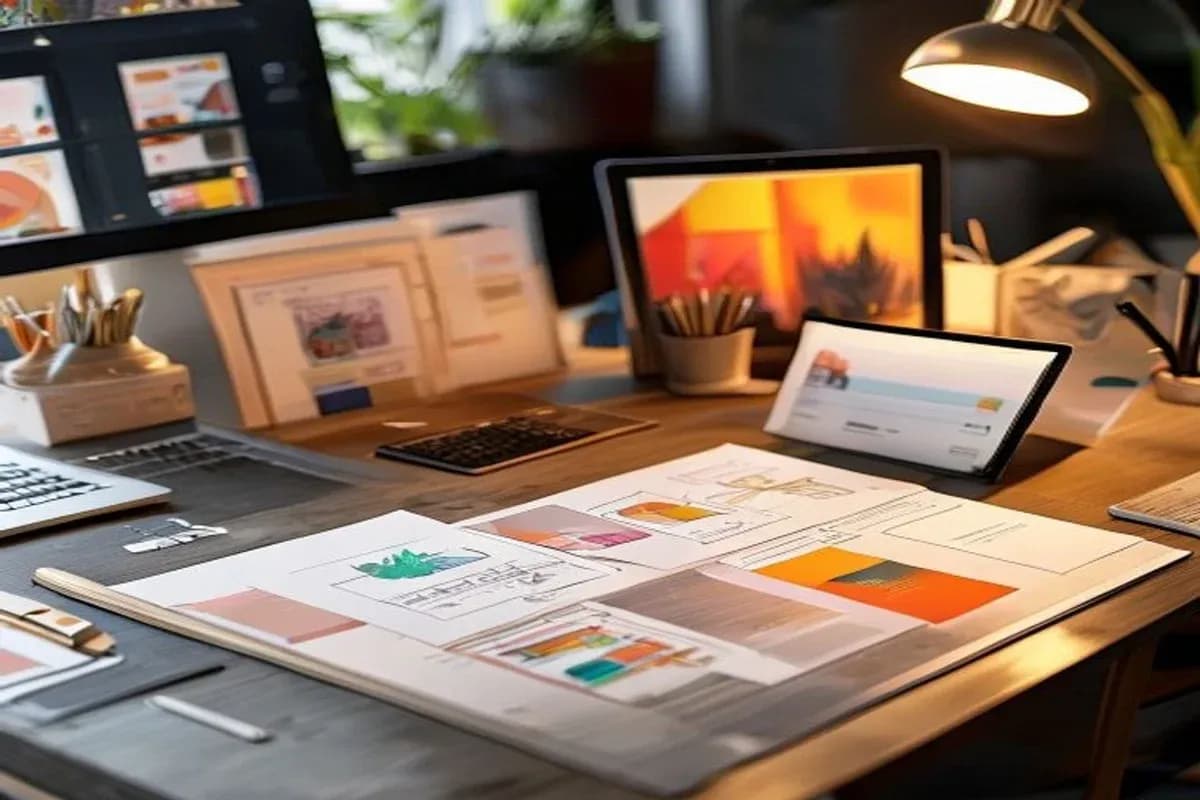
Story-Driven Visual Identity Is the Strongest 2026 Packaging Design Trend. The most impactful packaging design trend of 2026 is the shift from logo-placement packaging to story-driven packaging. Logo-placement packaging puts your logo on the front of the box or cup and fills the rest of the surface with brand colors or a simple pattern. Story-driven packaging uses the full surface area to communicate something meaningful: the origin of your recipe, your city, your team, your values, or a concept that resonates with your customer. Saudi restaurants that have adopted story-driven packaging consistently report higher social media sharing rates, higher customer recall, and stronger brand differentiation from competitors. The practical implementation: work with a brand designer (not just a packaging printer) to develop a visual narrative. What does your restaurant stand for? What story can be told on a pizza box lid, a cup sleeve, or a paper bag? The cost is in the design phase — the printing cost is identical to logo-placement packaging.
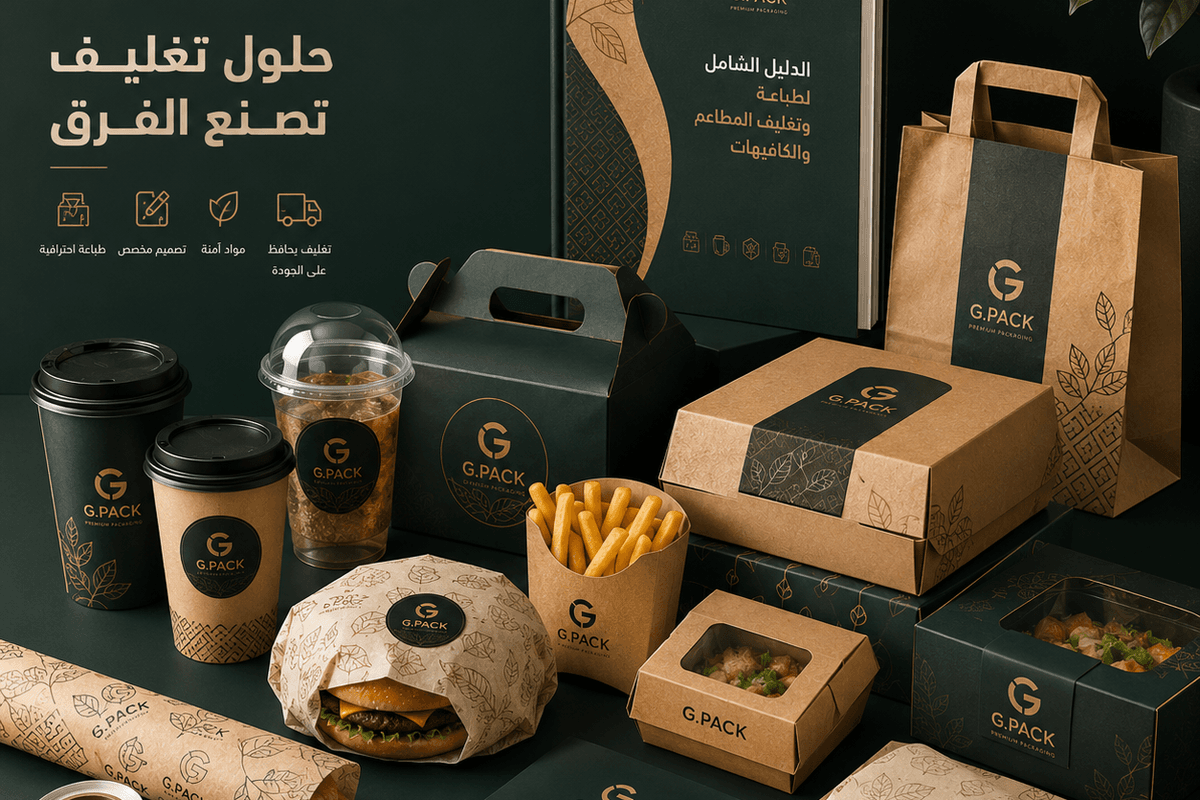
Sustainable Packaging Design Has Arrived in the Saudi Market with Real Force in 2025-2026. Consumer awareness of packaging waste in Saudi Arabia has increased significantly, driven by Vision 2030 environmental commitments, social media sustainability content, and a growing segment of Saudi consumers who actively factor environmental responsibility into their dining choices. Sustainable packaging design in 2026 means two connected things: the material choice (kraft paper, PLA-lined cups, recycled corrugated boxes, biodegradable containers) and the visual design language that communicates sustainability. The visual language of sustainability: unbleached kraft brown, natural green and earth tones, hand-drawn illustration style, minimalist design with whitespace, and explicit sustainability messaging (recyclable, compostable, plant-based). The economic reality: sustainable materials typically carry a 15-35% cost premium over conventional equivalents. For most Saudi restaurants, the brand value of the sustainability signal more than justifies this premium with the target customer segment.
| Design Direction | Visual Style | Saudi Market Fit | Implementation Cost | Social Media Performance |
|---|---|---|---|---|
| Story-driven brand narrative | Custom illustration, full-surface print | Very high — differentiated market | Medium (design investment) | Excellent — shareable content |
| Sustainable / eco aesthetic | Kraft, earth tones, hand-drawn | High — growing consumer demand | Medium-high (materials premium) | Very good — values-driven sharing |
| Instagram-optimized design | High contrast, photogenic, bold | Very high — social dining culture | Medium | Excellent — organic reach driver |
| Bold color contrast design | Vibrant contrasting color blocks | High — youth and delivery market | Low-medium | Very good |
| Seasonal / limited edition | Occasion-specific designs | Very high — Saudi occasion culture | Medium (repeat design cycles) | Excellent — creates urgency |
| QR code interactive design | Clean design plus QR | High — high smartphone penetration | Low (design + QR setup) | Good — drives app downloads |
Instagram-Optimized Packaging Design Remains a Primary Driver of Organic Brand Reach. The social dining culture in Saudi Arabia means that a significant percentage of restaurant visits and deliveries result in social media content. Packaging that is designed to be photographed — with strong visual contrast, distinctive color combinations, bold typography, and a clean composition that looks good in a phone photo — generates organic brand impressions that no paid advertising budget can replicate at comparable cost. The key Instagram-optimization principles for Saudi restaurant packaging in 2026: strong contrast between background and design elements (high-contrast packaging reads clearly in phone photography regardless of lighting conditions), a single dominant visual element that becomes the packaging signature (one strong image or design element is more memorable and more shareable than a complex collage), food color awareness (your packaging color scheme should complement rather than compete with the color of your food — a red and yellow packaging design clashes with a red-sauce pizza; a dark green and white design makes the same pizza pop visually).
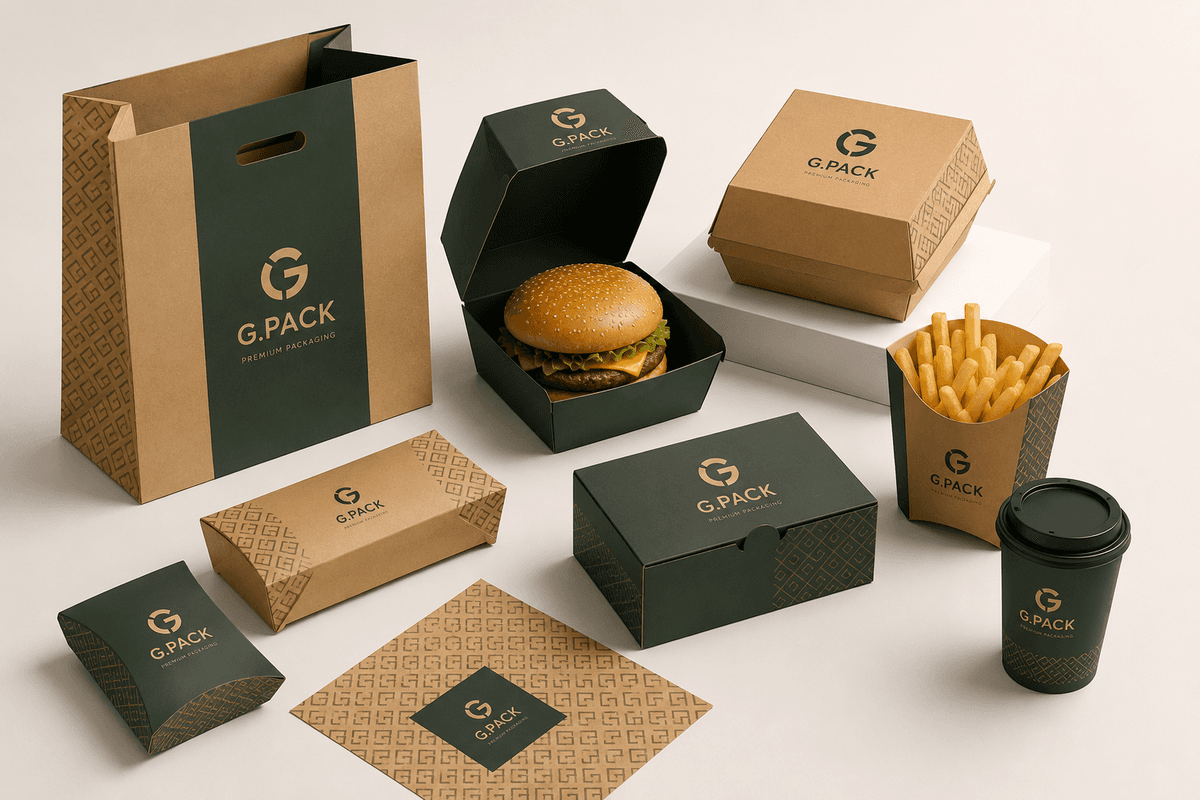
Bold Color Contrasts Dominate Saudi Restaurant Packaging Design in 2026. The bold contrast design trend — deep, saturated background colors paired with high-contrast typography and graphic elements — is the dominant aesthetic in Saudi restaurant packaging for 2026, particularly in the delivery and fast-casual segment. This trend is directly connected to delivery packaging: when a delivery bag arrives at a home or office, the packaging must create an immediate strong visual impression. Bold color contrasts achieve this — a deep navy box with gold typography, a deep red bag with white lettering, or an emerald green cup with cream design elements all create the strong visual identity signal that makes the brand memorable from the first delivery. The practical implication: if you are designing or redesigning packaging for a delivery-forward operation, evaluate a bold contrast palette before defaulting to lighter pastel or neutral palettes. Bold contrasts print well on corrugated cardboard and kraft paper — the two most common Saudi delivery packaging materials.
QR Code Interactive Packaging Has Moved Beyond Menu Links in 2026. QR codes on restaurant packaging were initially used simply as links to the digital menu. In 2026, leading Saudi restaurants are using QR codes on packaging for significantly higher-value customer interactions: loyalty program enrollment (scanning the QR code on the packaging registers the order in the loyalty program without requiring the customer to download an app first), social media follow (QR code links directly to the restaurant Instagram or TikTok with a follow prompt), exclusive content (QR code unlocks a recipe video, a behind-the-scenes kitchen video, or a chef message related to the specific food item in the packaging), and reorder shortcut (QR code opens the specific order basket for the item just received, allowing instant reorder with one tap). The cost of adding a QR code to packaging design is near-zero — it is a design element, not a materials or printing upgrade. The customer engagement value can be significant.
| Design Element | One-Time Design Cost SAR | Printing Cost Impact | Brand Value | Implementation Timeline |
|---|---|---|---|---|
| Logo placement only | 0-1,500 (logo resize) | Baseline | Low | 1-2 weeks |
| Story-driven illustration | 3,500-12,000 | None (same print spec) | Very High | 4-8 weeks with revisions |
| Eco material switch | 0 (no design change) | 15-35% material premium | Medium-High | 2-4 weeks |
| Bold color redesign | 2,000-6,000 | None-minimal | High | 3-6 weeks |
| QR code integration | 500-1,500 (design+QR setup) | None | Medium | 1-2 weeks |
| Seasonal limited edition | 1,500-4,000 per season | None (same print spec) | High (per occasion) | 4-6 weeks before occasion |
Typography Scale and Simplicity Dominate the 2026 Packaging Typography Landscape. The typography trend in Saudi restaurant packaging for 2026 reflects a broader shift across global brand design: large-scale, bold, simple typography that reads immediately and creates a strong brand impression without requiring the viewer to study the design. For Saudi restaurants, this means: one primary typeface (not three), used at a large scale that fills the packaging surface, with minimal supporting text. The restaurant name in large bold typography IS the design — it does not need illustration or graphic complexity to create a strong brand impression. For Arabic-English bilingual packaging (the standard for Saudi restaurants targeting both local and international customers), the typography pairing is critical. Arabic and Latin typefaces must be visually harmonious in weight, proportion, and style. Work with a designer who has specific experience in Arabic-Latin bilingual typography for packaging — this is a specialized skill that generalist designers often lack.
Seasonal Packaging Has Become One of the Smartest Embedded Marketing Tools in Saudi Restaurants. Saudi Arabia has a rich calendar of occasions that create natural packaging design opportunities: Ramadan (the most impactful), Eid Al-Fitr, Eid Al-Adha, Saudi National Day (September 23), Founding Day (February 22), Hajj season, and major sporting events. Seasonal limited-edition packaging creates three distinct brand values. First, it signals cultural connection — a Saudi restaurant that releases a beautiful Ramadan packaging design demonstrates that it understands and respects the occasion, which resonates deeply with the Saudi customer. Second, it creates scarcity and urgency — limited-edition packaging encourages customers to order during the occasion rather than postponing, because the special packaging will not be available indefinitely. Third, it generates social media sharing events — seasonal packaging launches are the most-shared food packaging content on Saudi social media. Planning: commission seasonal packaging designs 10-12 weeks before each target occasion to allow design iteration, approval, and production time.
Packaging Pricing 2026 — Investment Reference for Saudi Restaurants. Design and print cost reference for Saudi restaurants planning 2026 packaging updates: Paper cups (8oz, custom 2-color print, 3,000 units): SAR 1,500-2,100 total. Kraft paper bags (medium, custom 1-color print, 2,000 units): SAR 1,800-2,600 total. Pizza boxes (30cm, full-color print, 1,000 units): SAR 1,380-1,800 total. Corrugated delivery boxes (custom size, 2-color print, 1,000 units): SAR 2,200-3,400 total. Cup sleeves (custom 1-color, 3,000 units): SAR 800-1,200 total. Paper napkins (custom print, 5,000 units): SAR 600-900 total. These are printing costs only. Design fees for a complete packaging identity system: SAR 4,000-18,000 depending on scope and designer. Note that design cost is one-time — printing costs repeat with each order.
| Item | Plain (no print) | 1 Color | 2 Color | 4 Color CMYK | Min Order |
|---|---|---|---|---|---|
| Paper cup 8oz | 0.33-0.48 | 0.43-0.62 | 0.56-0.76 | 0.74-1.00 | 1,000 units |
| Kraft paper bag medium | 0.55-0.80 | 0.72-1.02 | 0.92-1.28 | 1.25-1.70 | 500 units |
| Pizza box 30cm | 0.56-0.76 | 0.82-1.06 | 1.06-1.38 | 1.38-1.80 | 1,000 units |
| Corrugated delivery box | 0.90-1.40 | 1.20-1.75 | 1.55-2.15 | 2.10-2.90 | 500 units |
| Cup sleeve | 0.13-0.22 | 0.18-0.28 | 0.23-0.34 | 0.32-0.46 | 2,000 units |
| Paper napkin | 0.06-0.10 | 0.09-0.14 | 0.12-0.18 | 0.16-0.24 | 2,000 units |
Photograph all your current packaging as a customer would. Compare against the six key 2026 directions: story-driven narrative, sustainability aesthetic, Instagram-optimized composition, bold color contrast, QR code integration, and seasonal adaptability. Identify the gaps.
What is your restaurant's origin, mission, or distinct identity? Write 3-5 sentences that capture what makes your restaurant worth remembering. This is the brief for your packaging designer — not "put the logo on the box" but "tell this story on the box."
Decide: conventional materials, eco-transition, or full eco-commitment? Each has different cost profiles and different brand signals. If you are targeting the premium or sustainability-aware Saudi customer segment, eco materials deliver disproportionate brand value.
Find a designer with demonstrated packaging and branding experience, ideally with Saudi market knowledge and Arabic-Latin bilingual typography competence. The design brief should include: your brand story, your target customer, the specific packaging items, color direction, and the social media context where the packaging will appear.
Identify the 3-4 occasions most relevant to your customer base: Ramadan is mandatory for almost all Saudi restaurants. Add National Day and one Eid. Commission seasonal designs 10-12 weeks before each occasion. Plan print runs to cover the occasion duration plus 10% buffer.
Choose one high-value QR destination: loyalty program enrollment, social media follow, or reorder shortcut. Add the QR code to your highest-volume packaging item. Track monthly scans to measure engagement.
Once design is approved, submit print-ready files to G-Pack with your full packaging specification: item type, size, material, print color count, and quantity per item. Request a physical proof before committing to the full print run.
Every quarter, photograph your packaging as a customer does, check social media for organic packaging shares, and compare your visual identity to competitors. Packaging is a live brand asset that should evolve with your positioning.
10 Common Packaging Design Mistakes to Avoid
(1) Putting the logo small on a white background — wastes the entire print surface. (2) Using the same design for all packaging types — each item has a different brand role. (3) Ordering packaging before the brand identity is finalized — reprinting is expensive. (4) Ignoring bilingual typography quality — poor Arabic-Latin pairing signals poor attention to quality. (5) No seasonal packaging plan — missing Ramadan is a major brand opportunity lost. (6) Using QR codes that link to a generic homepage — always link to a specific high-value destination. (7) Choosing packaging color based on personal preference rather than food photography performance. (8) Ordering minimum quantities of seasonal packaging — run out before the occasion ends and you lose the brand moment. (9) Designing for the restaurant interior rather than the delivery context — most Saudi customers experience your packaging at home. (10) Not photographing your packaging on actual food before approving the final design — the packaging must look good with the food inside, not just in a flat design mockup.
Story-driven visual identity. The trend with the highest measurable impact on customer recall, social media sharing, and brand differentiation is moving from logo-placement packaging to packaging that communicates a genuine brand story or visual concept. The printing cost is identical — the investment is in the design phase. Saudi restaurants that have adopted story-driven packaging consistently outperform competitors on brand awareness metrics.
Design cost for a complete packaging identity system: SAR 4,000-18,000 (one-time). Print costs per unit: cups SAR 0.43-1.00, bags SAR 0.72-1.70, pizza boxes SAR 0.82-1.80, delivery boxes SAR 1.20-2.90. These costs scale favorably at volume — the design is one-time, and printing per-unit cost decreases at higher quantities. For a restaurant doing 100 orders per day, the total annual packaging print cost at standard print specification is typically SAR 25,000-80,000 depending on packaging mix.
For restaurants targeting the premium, health-conscious, or environmentally aware Saudi customer segment: yes, with a clear sustainability narrative. For mass-market fast food: eco packaging adds cost without proportional brand benefit for the core customer segment. The strongest approach is targeted: use eco materials on the packaging items most visible to the target customer (the cup they carry, the bag they walk with), while optimizing conventional materials for internal packaging the customer does not see.
Four principles: (1) high contrast between background and design elements — high-contrast packaging photographs well in any lighting; (2) one dominant visual element that becomes the brand signature; (3) color palette awareness relative to your food color — the packaging should make the food look better, not compete with it; (4) a packaging detail that creates surprise or delight when the customer opens the order. Add a QR code that links to social media follow to convert packaging admirers into followers.
Commission the design 10-12 weeks before Ramadan. Design brief: Saudi cultural context (crescent, geometric Islamic patterns, warm amber and gold tones are the most resonant), your brand story adapted to Ramadan values (generosity, family, community), and bilingual Arabic-English execution at equal quality. Calculate your projected Ramadan order volume (typically 1.5-3x normal daily volume) and add 15% buffer. Order in one production run — split ordering creates color matching risk.
Yes. Start with the highest-impact single packaging item: the cup for a cafe, the pizza box for a pizzeria, the primary delivery bag for a cloud kitchen. A single-item packaging design brief costs SAR 1,500-4,000 for a strong design. One well-designed packaging item creates more brand value than six mediocre ones. Expand to other packaging items as volume and budget grow.
Total timeline: design phase (2-6 weeks with revisions), design approval (1 week), production at G-Pack (14-21 days), delivery (1-3 days). Total: 6-11 weeks from design brief to first delivery. For seasonal packaging, work backwards from the occasion date with at least 12 weeks. For standard operational packaging, keep 8 weeks of lead time in your reorder cycle.
For cups and boxes, printing beyond the primary front panel adds approximately 20-40% to printing cost but significantly increases brand surface area. For delivery packaging specifically, printing on all exterior faces is worthwhile — the bag or box may be oriented any direction when carried or placed on a table. Evaluate each packaging item on the brand impression per additional print cost, not as a blanket rule.
Bold, saturated colors perform best in the Saudi delivery context. Deep navy, emerald green, deep red, and deep warm brown are the highest-performing background colors for Saudi restaurant packaging in 2026 — they provide high contrast for logo and typography, they photograph well on social media, and they communicate premium quality. Avoid light pastel backgrounds for delivery packaging — they look unfinished on corrugated cardboard surfaces. For dine-in packaging (cups, napkins, wrapping paper), lighter tones including cream and kraft are entirely appropriate.
Core packaging identity: review every 3 years. Seasonal packaging: every occurrence (Ramadan, National Day, Eid annually). Minor refresh (color update, typography refinement): every 2 years. Major rebrand: as needed for significant brand repositioning. The mistake most Saudi restaurants make is never updating — packaging designed in 2018 does not communicate a 2026 brand standard, regardless of food quality.
G-Pack designs and produces custom restaurant packaging for Saudi operators — cups, bags, boxes, and seasonal editions. Full design support available. Free samples before volume orders.
Get a Free Quote