Complete guide to custom printed burger boxes for Saudi restaurants in 2026 — structural types, ventilation requirements for delivery, printing specifications, pricing benchmarks, and how to order correctly the first time.
The burger box is not just a container — it is a critical part of the burger eating experience. The moment a customer opens your box and sees a freshly assembled burger is the precise point where your brand makes its strongest impression. A burger that tastes excellent but arrives in a compressed, limp, steam-damaged box creates a weaker brand impression than the food quality deserves. Conversely, a burger presented in a well-engineered, cleanly printed box with your logo elevates the perceived quality of every ingredient inside — before the first bite. Saudi Arabia's burger restaurant market is among the most competitive food service segments in the Kingdom, with specialty and premium burger concepts opening at an accelerating rate alongside established chains. For operators in this market — from independent specialty concepts to multi-branch operations — the burger box is a non-negotiable brand investment. This guide covers everything: structural types and which to choose, the ventilation question that separates good boxes from great boxes, custom printing specifications and options, pricing benchmarks, and how to place your first or improved order correctly.
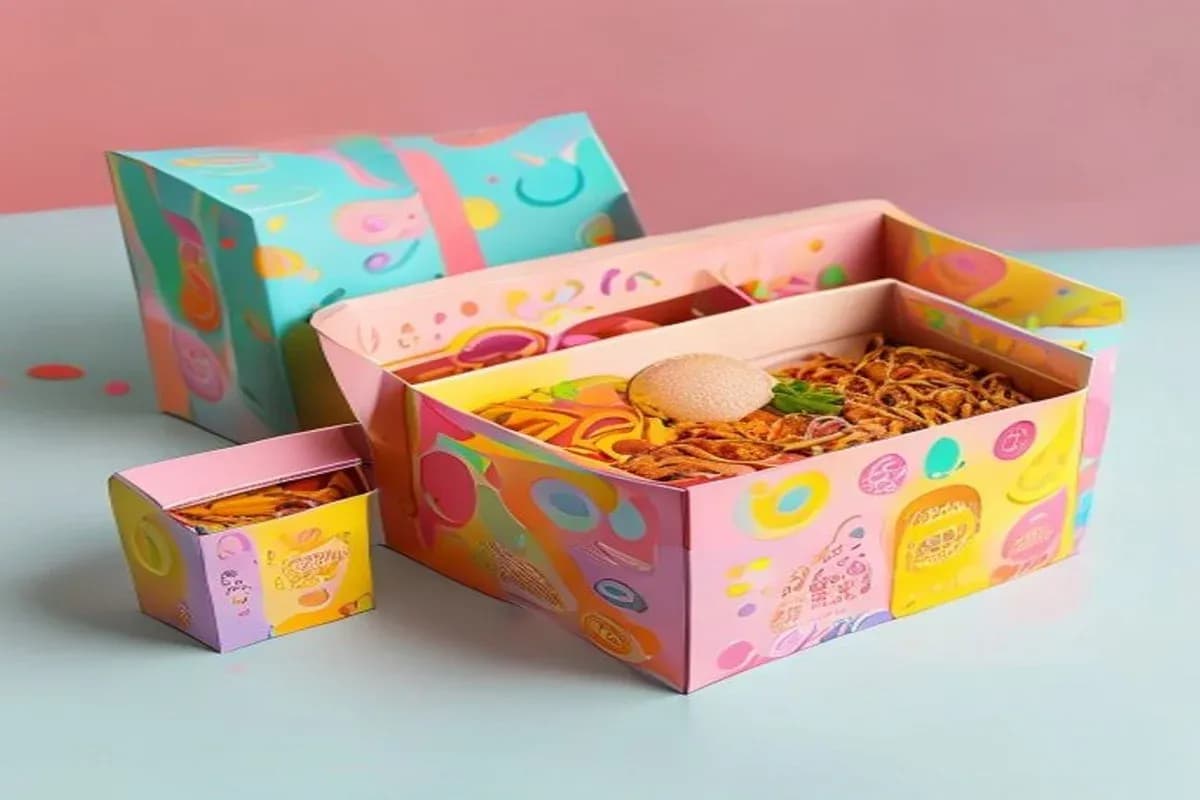
Types of Burger Boxes — Making the Right Structural Choice. Burger boxes come in three primary structural designs, each with distinct performance characteristics. Clamshell boxes: the most common format — a single piece of cardboard that folds open like a clamshell with hinged lid and base connected at the back. Easy to assemble, fast for staff in high-volume service, adequate structural strength for standard burgers. The limitation: the open-close mechanism allows steam to escape and re-enter, potentially softening the bun during long waits. Separate lid boxes (two-piece): a separate flat lid that places over the box base. Allows maximum air circulation and reduces steam buildup. Preferred for burgers with particularly crispy elements (onion rings, crunchy toppings) where maintaining crispness is a priority. Assembly requires slightly more staff time. Wrap boxes: a flat cardboard sheet with fold lines that wraps and locks around the burger. Minimal material, fastest assembly, but less structural protection during delivery. Suitable for immediate on-site consumption; not recommended for delivery.
| Box Type |
|---|

Complete guide to custom pizza boxes for Saudi restaurants 2026 — size selection, corrugated specifications, grease resistance, interior lid printing, custom pricing, and G-Pack ordering.

Complete guide to sandwich wrap paper for Saudi restaurants 2026 — greaseproof vs foil types, custom printing costs, box plus wrap premium presentation, ROI calculation, and G-Pack ordering.
| Best Application |
|---|
| Steam Control |
|---|
| Custom Printability |
|---|
| Price Range (SAR/1,000) |
|---|
| Clamshell — kraft cardboard | All burger types, standard service | Moderate | Excellent — large print area | 180–320 |
| Clamshell — grease-proof coated | Premium burgers, high-fat content | Good | Very Good | 220–380 |
| Separate lid box (2-piece) | Specialty burgers, delivery focus | Best — separate ventilation | Excellent | 240–420 |
| Wrap box (flat fold) | Quick service, on-site only | Poor for steam retention | Good — flat surface print | 120–200 |
| Eco bagasse clamshell | Eco-positioning, sustainability story | Good | Limited — brown tone only | 280–450 |
Ventilation Holes — The Detail That Changes Everything. Ventilation holes in the burger box lid are not an aesthetic choice — they are a functional engineering decision that directly affects the quality of your burger when it reaches the customer. Without ventilation, steam from the hot burger accumulates inside the sealed box. This steam condenses on the inner surfaces and the bun, softening the bottom bun within 3-4 minutes of boxing, converting a pleasantly toasted bun into a soggy, collapsed base. With ventilation holes (typically 3-5 small holes in the lid), steam escapes continuously, maintaining the structural integrity of the bun and preserving the textural experience the customer expects. For in-restaurant service where burgers travel 30 seconds from kitchen to table: ventilation matters but is less critical. For takeaway and delivery where burgers may travel 20-40 minutes: ventilation holes are non-negotiable. The difference between a vented and non-vented burger box on a 30-minute delivery journey is immediately obvious to the customer. Always specify vented boxes for any operation with a delivery component.
Custom Printing on Burger Boxes — From Idea to Production. Burger boxes offer significantly more print surface area than cups — a standard clamshell box provides approximately 400-600 cm² of flat printable surface across the lid and base exterior, compared to the narrow cylindrical surface of a cup. This generous surface enables richer brand storytelling: your logo, brand colors, a tagline, social media handles, and even supplementary brand messaging can all fit on a well-designed burger box without feeling crowded. The most effective custom burger box designs follow three principles: a dominant brand element (logo or primary color) visible on the lid from the top view, clear contrast between background and printed elements, and typographic hierarchy where the brand name reads before secondary information. For flexographic printing — the most common method for burger boxes at 2,000+ units — designs should use 1-3 solid Pantone colors without complex gradients. For digital printing under 1,000 units, full color including photographs and gradient backgrounds is achievable.
| Specification | Recommended Value | Notes |
|---|---|---|
| Cardboard weight (gsm) | 350-450 gsm | Minimum 350gsm for structural integrity under burger weight |
| Inner coating | PE or grease-proof coating | Prevents oil seepage through the box base and sides |
| Ventilation holes | 3-5 holes in lid, 4-6mm diameter | Essential for delivery orders — specify on every order |
| Printing method | Flexo for 2,000+, Digital for under 1,000 | Both methods produce excellent results on flat cardboard |
| Color count | 1-3 colors (flexo), unlimited (digital) | 2-color designs are most cost-effective for flexo |
| Minimum print size | 5mm typography minimum | Smaller text loses legibility on recycled kraft surface |
| Box dimensions | Measure your actual burger — 110×110, 130×130, or 150×150mm typical | Always measure before ordering: a box 1cm too small is unusable |
Costs and What to Expect. A standard burger box without custom printing: SAR 0.25-0.45 per box depending on size (M: 110×110mm), cardboard weight, and order quantity. A custom printed burger box with 1-color flexo print at 3,000 units: SAR 0.35-0.55 per box. At 5,000 units: SAR 0.28-0.44 per box. At 10,000 units: SAR 0.22-0.35 per box. Initial flexo plate engraving: SAR 600-1,500 one-time fee (retained permanently for reorders). Digital printed burger box at 1,000 units: SAR 0.45-0.70 per box — full color, no plate fee. Per-burger-order packaging cost benchmark: a healthy target is SAR 0.35-0.75 for the complete primary packaging (box + bag + sauce cups + napkin), representing 3-5% of a SAR 15-25 burger order value. Custom printing typically adds only SAR 0.05-0.15 per box to this total — a cost that is easily justified by the brand impression it creates.
| Box Size | 1,000 pcs | 3,000 pcs | 5,000 pcs | 10,000 pcs |
|---|---|---|---|---|
| Small (100×100mm) — 1 color | 280–370 | 210–280 | 165–220 | 130–170 |
| Medium (110×110mm) — 1 color | 310–420 | 235–315 | 185–250 | 145–190 |
| Medium (110×110mm) — 2 colors | 380–510 | 285–385 | 225–300 | 175–230 |
| Large (130×130mm) — 1 color | 380–510 | 285–385 | 225–300 | 175–230 |
| Large (130×130mm) — 2 colors | 460–620 | 345–465 | 270–365 | 210–280 |
Multi-Branch and Growth Planning
If you operate more than one branch, or plan to expand, standardize your box design from the beginning. A unified box design across all branches costs the same per unit as a single-branch order when combined, and builds a far stronger brand recognition than multiple variations. Design once, print at combined volume — lower price, stronger brand.
Assemble your largest menu burger fully — with all toppings, sauces, and the top bun. Measure height, width, and depth. Your box interior must be at minimum 10mm larger in each dimension than your largest burger. This measurement step prevents the most expensive mistake in burger box ordering.
If you offer takeaway or delivery: specify 4+ ventilation holes in the lid, minimum 5mm diameter. If in-restaurant only: standard venting is sufficient. Include ventilation specifications in writing on every order with every supplier — it is not always the default.
Get your box's flat die-cut template from your supplier before finalizing any artwork. Design on the actual template shape, not a generic rectangular approximation. Ensure your key brand elements (logo, name) fall on the main lid panel and are not near fold or cut lines.
Order sample boxes in your chosen specifications. Assemble your actual burger inside. Close the box and leave it for 15 minutes — then open and assess bun condition. Check structural integrity, print quality, and whether the box closes securely without being forced.
Request pricing at 1,000, 3,000, 5,000, and 10,000 units from each supplier. The volume curve reveals your optimal order size. Include complete specifications: size, gsm, coating type, color count, ventilation holes, and delivery destination.
Order 6-8 weeks of supply. Track your daily box consumption for 4 weeks to establish accurate reorder projections. Set your reorder trigger at 3 weeks of remaining stock — never fewer.
Measure your assembled burger — width, depth, and height — with all toppings and the top bun fully assembled. Your box interior should be 10-15mm larger in each dimension. Common Saudi burger restaurant sizes: 100×100mm for sliders and small burgers, 110×110mm for standard smash and single burgers, 130×130mm for large double burgers and loaded burgers, 150×150mm for tower burgers and premium double-stack formats.
For delivery orders, specify minimum 3-5 ventilation holes in the lid, each 4-6mm in diameter. More holes of smaller diameter are better than fewer large holes for even steam distribution. Always specify this requirement in writing when ordering — it is not always the default configuration.
Digital printing: typically 500-1,000 boxes, no plate fees, full color capability, 5-10 day lead time. Flexographic printing: typically 2,000-3,000 boxes, one-time plate fee of SAR 600-1,500, 14-21 day lead time, lowest per-unit cost at volume. G-Pack recommends digital for first orders to test your design before committing to flexo quantities.
Natural kraft (brown) cardboard has a casual, craft-food-friendly aesthetic that works well for artisan and specialty burger concepts. White coated cardboard provides a cleaner print background with higher color vibrancy — recommended for brands with strong color-based identity. Coated white adds approximately 8-12% to unit cost versus uncoated kraft. Both options are available with full custom printing.
Three steps: (1) Always use a grease-proof inner coating or PE-lined cardboard — raw kraft absorbs oil and collapses within minutes. (2) Specify ventilation holes in the lid — this is the most impactful single step for delivery quality. (3) Box the burger as late as possible before handoff to the delivery driver — minimizing the time in a closed box before transit begins.
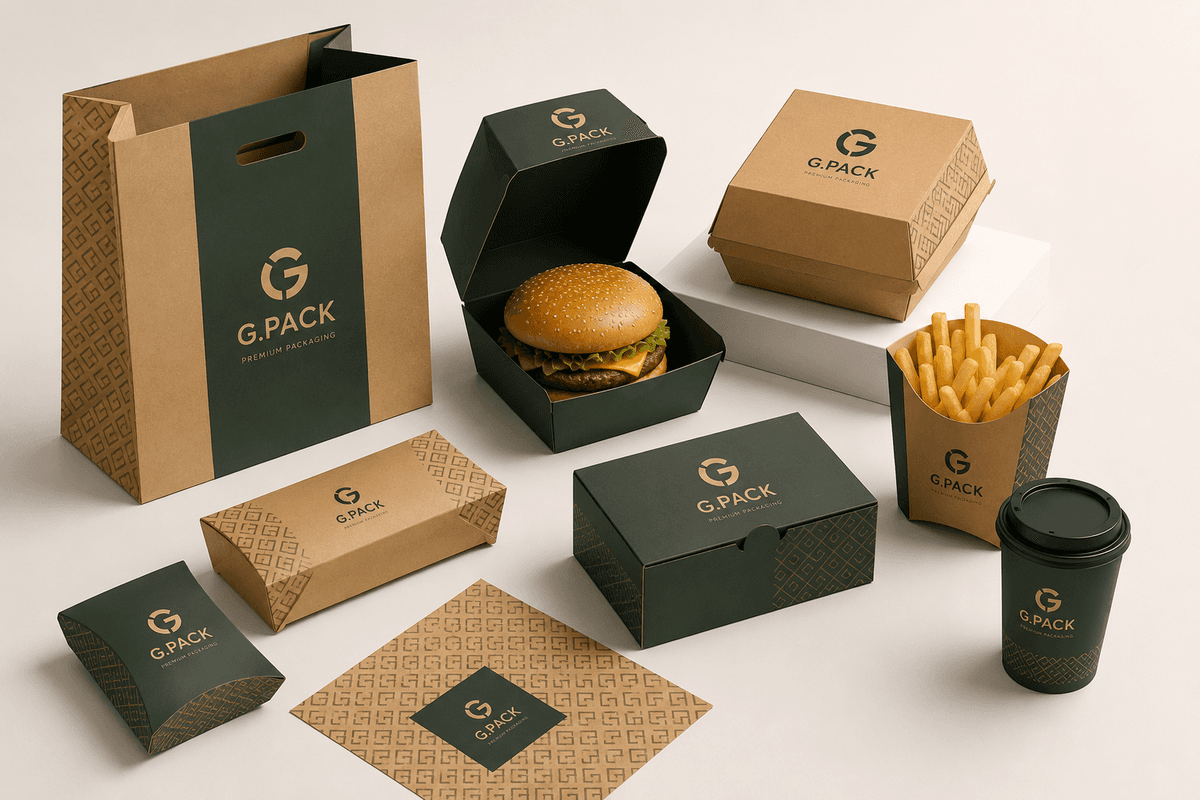
G-Pack specializes in custom printed burger boxes for Saudi restaurants — all sizes, all specifications, digital and flexo printing with physical samples before every production commitment.
Get a Free Quote