Complete guide to custom kids meal boxes for Saudi restaurants 2026 — safety standards, compartment design, activity printing, character design, pricing benchmarks, and G-Pack ordering.
A kids meal is not just a smaller version of an adult meal — it is a complete experience. The child's emotional response to receiving their meal, the playfulness of the packaging, the ability to open the box independently, and the activities integrated into the design all determine whether the kids meal creates joy and brand loyalty or simply delivers calories. In Saudi Arabia's family-focused restaurant culture — where family outings are a core social activity and children are central participants — the kids meal box is a significant brand investment opportunity that is vastly underutilized by most operations. A child who loves their meal box will want to return to the same restaurant and will carry the branded box throughout the restaurant, creating brand impressions for every adult at nearby tables. This guide covers kids meal box design, safety standards, material specifications, printing options, and pricing for Saudi restaurants in 2026.
Safety First — The Non-Negotiable Standard for Kids Meal Packaging. Before any design consideration, kids meal packaging must meet safety standards that differ from adult packaging. Children interact with packaging differently — they put it near their mouths, chew on corners, and have close facial proximity to the surface during eating. Material safety requirements: food-contact safety certification (all materials, inks, and coatings must be certified food-safe), non-toxic ink certification (inks on any surface the child's hands may touch must be non-toxic — soy-based inks are the recommended standard), sharp edge elimination (all box edges and corners must be folded and sealed to eliminate cut edges accessible to a child), no small detachable parts on the box (any decorative element a child could detach must be printed, not physically attached), and food-safe adhesive on any interior bonded surface.
| Component | Standard Format | Ideal Packaging | Key Spec |
|---|---|---|---|

Complete guide to custom pizza boxes for Saudi restaurants 2026 — size selection, corrugated specifications, grease resistance, interior lid printing, custom pricing, and G-Pack ordering.

Complete guide to sandwich wrap paper for Saudi restaurants 2026 — greaseproof vs foil types, custom printing costs, box plus wrap premium presentation, ROI calculation, and G-Pack ordering.
| Main item (burger/chicken/wrap) |
| Small box or compartment |
| 350gsm+ coated box, child-accessible lid |
| Non-toxic coating, rounded corners |
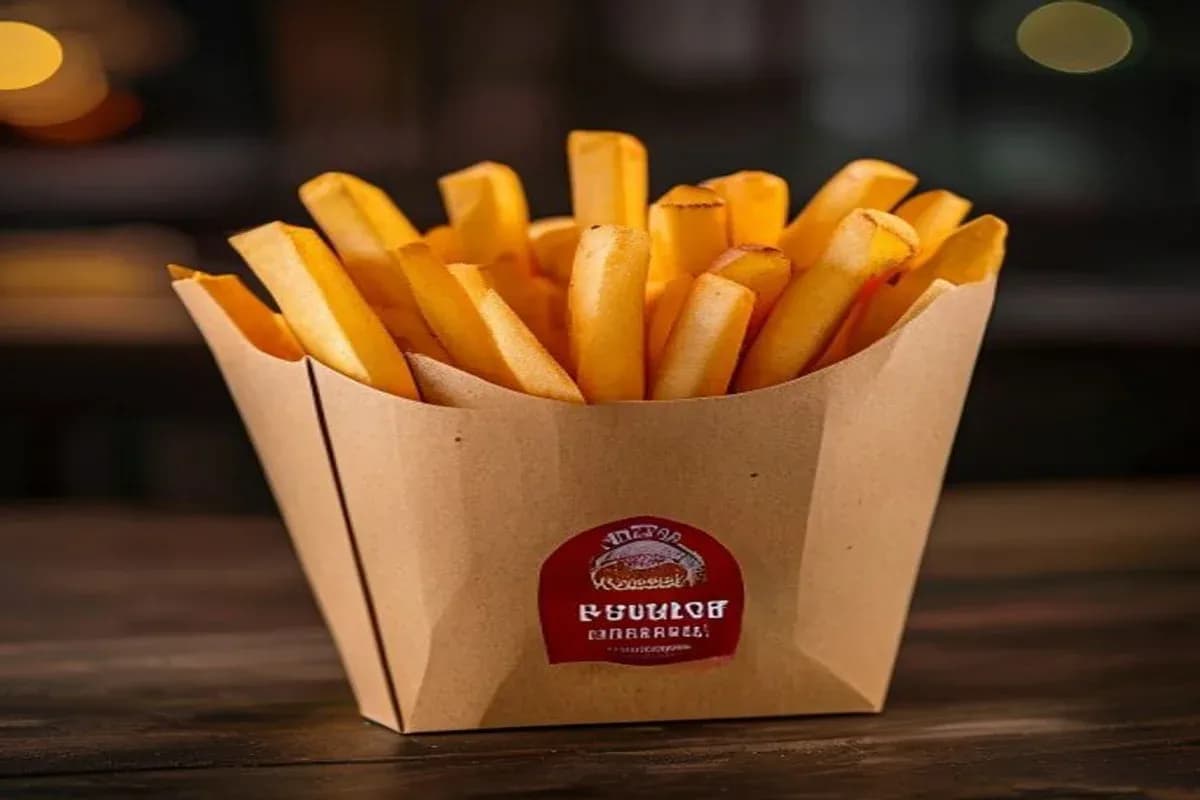
| Fries or side item | Integrated compartment or small sleeve | Vented, PE-lined fries section | Oil barrier, steam vent |
| Drink (juice/milk/water) | Juice box or small cup | Sealed cup with straw or juice pack | Child-grip size (8oz max) |
| Sauce | Single-serve packet or built-in compartment | Sealed sauce packet or sauce cup | Sealed, child-openable |
| Toy or activity | Inside box or separate bag | Enclosed with child-accessible reveal | Non-toxic, age-appropriate |
| Outer container | Compartment tray or box with lid | Full-feature kids box with print | Child-scale dimensions, fun design |
Box Design — Function Before Aesthetics. A kids meal box must be physically functional for a child before it can be aesthetically appealing. Functional design requirements: opening mechanism (a child aged 4-10 should be able to open the box independently — tuck-lock closures requiring adult finger strength are inappropriate; push-tab or lift-tab openings are child-accessible), grip and portability (the box should be carryable by a child without risk of dropping — handles or grip notches serve this function), compartmentalization (kids meals typically include 3-5 items; integrated compartments keep items separated and accessible without the child managing multiple containers), appropriate sizing (child-scale dimensions — approximately 160 x 140 x 80mm — feel right in small hands and on child-height table settings), and tray option for younger children (for ages 3-5, a flat tray with visible compartments and no lid may be more accessible and less frustrating than a lidded box).
| Standard | Requirement | Test Method | Fail Condition |
|---|---|---|---|
| Food contact safety | All materials certified food-safe | Supplier certificate verification | Any non-certified material present |
| Ink safety | Non-toxic ink on all contact surfaces | Supplier ink certificate | Toxic ink on any surface child may touch |
| Edge safety | No exposed sharp cut edges | Physical inspection of all edges | Any sharp fold or cut edge accessible to child |
| Structural integrity | Box holds shape when child carries or drops it | Drop test from 80cm (child table height) | Box collapses or contents spill |
| Compartment integrity | Compartments remain separated during handling | Fill with food, shake 30 seconds | Food crosses compartment boundary |
Printing and Visual Design for Kids Meal Boxes. The visual design of a kids meal box directly drives the child's meal experience — and the parent's decision to return. Design principles for Saudi kids meal boxes: character and personality (the box should feel like it has a character — a mascot or story the child can engage with), bright primary colors (red, yellow, blue, and green are the colors children most strongly associate with positive play — the palette should be saturated and energetic), age-appropriate complexity (ages 3-5: simple shapes and large characters; ages 6-10: games, mazes, or activity elements on the box surface; ages 10+: a slightly cooler aesthetic), activity integration (a maze, coloring guide, word search, or quiz on the box surface extends engagement beyond the meal and extends brand impression time), and parent-brand consistency (the kids box should clearly belong to the same brand family as adult packaging — same logo, similar color family — while having its own expressive character).
| Box Format | Plain | 2 Color Print | 4 Color Print (CMYK) | Full 6-face Print | Notes |
|---|---|---|---|---|---|
| Compartment tray (160x140x50mm) | 440-620 | 680-900 | 900-1,180 | 1,180-1,540 | Standard Saudi kids meal format |
| Full box with lid (160x140x80mm) | 480-680 | 740-980 | 980-1,280 | 1,280-1,660 | Best for toy or activity inclusion |
| Premium box with handle (190x160x100mm) | 560-780 | 860-1,120 | 1,120-1,460 | 1,460-1,900 | Premium positioning, carry handle |
| Tray with integrated cup slot | 520-720 | 800-1,060 | 1,060-1,360 | 1,360-1,760 | Built-in cup holder format |
| Eco bagasse tray | 680-940 | N/A (label only) | N/A (label only) | N/A (label only) | Eco version for organic concepts |
Market Reference — The Saudi Kids Meal Packaging Standard
The benchmark for kids meal packaging in Saudi Arabia is set by international QSR chains: a Happy Meal-style integrated box, 4-6 color printing, character mascot, activity element on box, toy enclosed inside. Local Saudi restaurants that match this standard create the same emotional engagement at a fraction of the international chain marketing budget. The packaging cost per kids meal: SAR 0.90-1.46 for a premium full-color box at 3,000-unit volume. The meal price: SAR 25-45. Packaging as percentage of meal price: 3-5%. The brand loyalty created: often the primary driver of a family's restaurant choice for the next 12-18 months.
Identify your primary kids age target (3-5, 6-8, 8-12). This determines design language, compartment format, activity type, and opening mechanism. Document the brief before engaging any designer.
Before any kids meal packaging order, obtain: food-contact safety certificate for all materials, non-toxic ink certificate for all printing inks, and sharp-edge audit confirmation from supplier.
Have children in your target age range attempt to open the box independently. If more than 3 in 10 cannot open without help, the mechanism is too complex. Revise before production.
Brief a designer for kids meal box design: age range, brand color family, mascot concept, activity type. Request packaging-ready artwork files at print specifications.
Count daily kids meal orders. Multiply by 45 days. Submit artwork and specifications to G-Pack with this quantity. Request a physical sample for safety inspection before full production approval.
Map the calendar: Eid Al-Fitr, Eid Al-Adha, National Day, summer. Plan artwork submission 8-10 weeks before each seasonal change. Archive seasonal designs digitally for reuse in subsequent years.
If the kids box has multiple compartments or requires specific assembly, train all kitchen staff on the standard. Consistency in kids box assembly is part of the experience quality.
Record daily kids meal order volume before the packaging upgrade. After 60 days, compare. Effective kids packaging increases repeat-visit frequency for family customers.
All kids meal packaging must use food-safe certified materials, non-toxic printing inks (soy-based recommended), no exposed sharp edges, and food-safe adhesives on any interior bonded surface. Request certification documentation from any supplier before ordering. SFDA food packaging requirements apply to all food contact materials.
A compartmentalized box with lid (160x140x80mm standard) with: main item compartment, vented PE-lined fries section, sauce recess, full 4-color exterior printing with character design, activity element on interior lid, and push-tab or lift-tab opening. This format matches the Saudi market premium standard.
At 1,000 units: SAR 900-1,180 for 4-color compartment boxes. At 3,000 units: lower per-unit price. First-order setup fee: SAR 800-1,400. All reorders are setup-fee free. Contact G-Pack for pricing on your specific dimensions and print colors.
Commission a character illustrator or brand designer: age target (4-10), brand color family, personality attributes (adventurous, funny, curious). The character should be designed for use across all kids meal packaging surfaces and in-restaurant graphics. G-Pack can connect you with approved designers for packaging character development.
Yes — strongly recommended. Activity elements (mazes, word searches, dot-to-dot) extend the child's engagement beyond the meal, create positive brand association, and give parents a positive topic during the meal. No additional cost beyond the standard print area.
Yes — and it is recommended. Eid designs, National Day themes, and summer designs maintain child interest and provide novelty that drives repeat purchases. Plan artwork submissions 8-10 weeks before each activation. MOQ applies to each seasonal design.
Standard dimensions: outer box 160x140x80mm, fries section (if separate) 90x55x115mm, drink 8oz child-grip cup. Test with actual children in your target age range before production to confirm the box feels right in small hands and on child-height table settings.
Daily kids meal orders x 45 days = 6-week buffer target. Example: 45 kids meals per day x 45 = 2,025 boxes. Order 2,025 (above the 1,000-unit MOQ). If daily volume is 20 x 45 = 900 — below MOQ — order 1,000 (MOQ minimum).
G-Pack supplies food-safe certified kids meal boxes in all formats. Free samples for safety and dimension testing. Character design consultation available. Minimum 1,000 units.
Get a Free Quote