Complete guide to custom fries boxes for Saudi restaurants 2026 — sleeve vs delivery box formats, steam venting specifications, PE inner lining, custom printing prices, and how to eliminate soggy fries delivery complaints.
French fries are one of the best-selling items across fast food, casual dining, and delivery kitchens in Saudi Arabia — ordered as a standalone snack, as a combo side, or as a delivery add-on in virtually every restaurant category. Yet fries are treated as an afterthought in packaging decisions more often than any other item. The result is the most common delivery quality complaint in the Saudi market: fries that arrive soft, limp, and disappointing — undermining a meal experience that was otherwise excellent. The fries box is not just a container. It is the functional enabler of a good fries experience over a 15-30 minute delivery window, and it is a high-visibility brand surface that customers interact with at table or while eating — making it one of the most photographed individual packaging items in social media food content. This guide covers everything about fries box selection, specification, printing, and ordering for Saudi restaurants in 2026.
Why French Fries Need Specialized Packaging. French fries create packaging challenges that no other food item replicates: The steam problem: freshly fried potatoes are at approximately 185-195°C when they exit the fryer. As they cool in an enclosed container, they produce significant steam. This steam — if trapped — condenses on the fry surface within 5-8 minutes, making the exterior soft and destroying the crispy texture that defines good fries. The steam must be managed, not just contained. The oil problem: fried foods release residual oil as they cool. A fries box without adequate oil barrier properties will have oil seeping through the cardboard walls within 10-15 minutes — creating an unpleasant, greasy exterior that the customer handles and that photographs poorly. The heat loss problem: fries lose heat faster than any other food item because of their high surface-area-to-volume ratio. Once fries drop below approximately 60°C, their texture degrades significantly. The packaging must slow this heat loss while simultaneously allowing steam to escape — an engineering balance that requires thoughtful specification. The display problem: fries are often served in open-top or partially open formats for in-restaurant dining. The box design must allow easy customer access to the fries without causing them to spill.
| Format |
|---|

Complete guide to custom pizza boxes for Saudi restaurants 2026 — size selection, corrugated specifications, grease resistance, interior lid printing, custom pricing, and G-Pack ordering.

Complete guide to sandwich wrap paper for Saudi restaurants 2026 — greaseproof vs foil types, custom printing costs, box plus wrap premium presentation, ROI calculation, and G-Pack ordering.
| Best Use Case |
|---|
| Steam Management |
|---|
| Oil Resistance |
|---|
| Dine-In Display |
|---|
| Print Surface |
|---|
| Sleeve (open-top) | Dine-in, take-counter service | Excellent — fully open | Medium — sides need lining | Excellent — fries visible | Good — flat printable face |
| Tray with divider | Loaded fries, multi-topping | Good — partially open tray | Good with PE lining | Excellent — toppings visible | Excellent — wide flat surface |
| Flap-lid box (vent holes) | Delivery, takeaway | Good — vent holes in lid | Good with coated interior | Moderate — lid conceals | Excellent — 5 printable faces |
| Cone/paper funnel | Dine-in, street food style | Good — top open | Medium — paper lining needed | Good — classic visual | Limited — curved surface |
| Compartment box (fries + sauce) | Combo service | Moderate — lid traps steam | Good with coated interior | Good — compartmentalized | Excellent — full-face print |
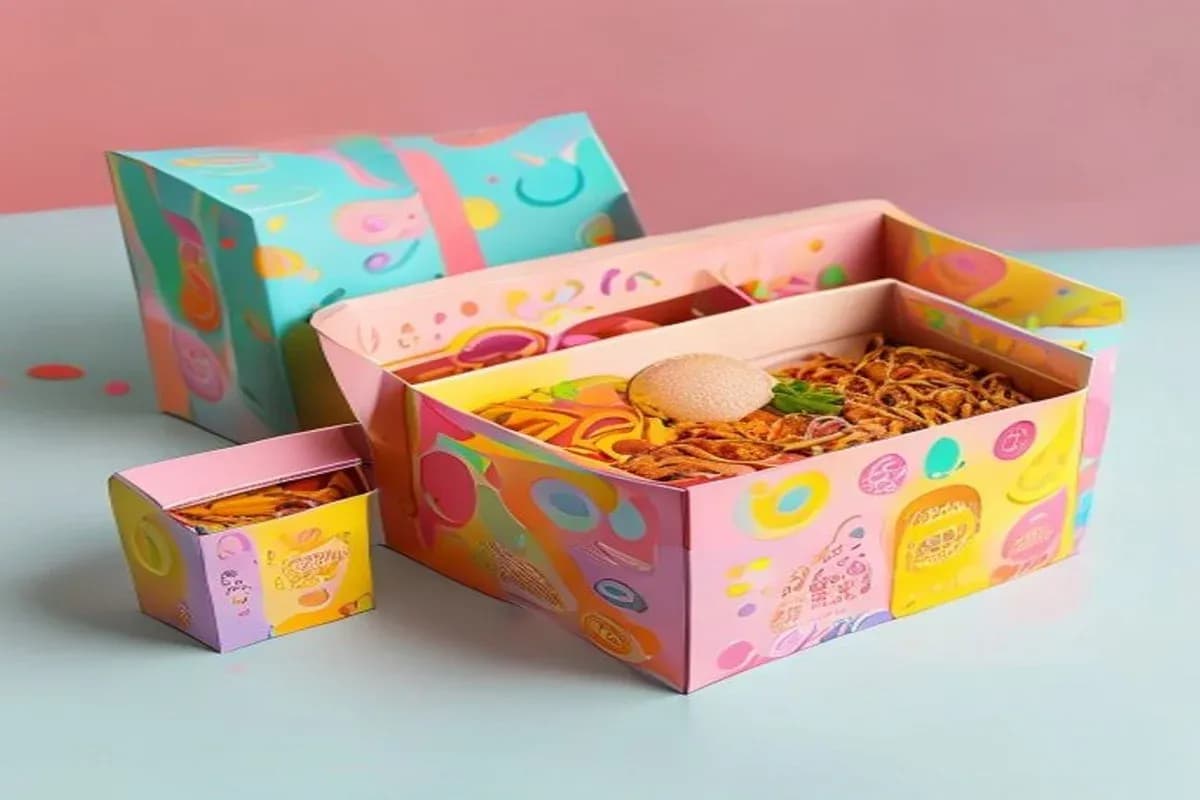
Types of Fries Packaging and When to Choose Each. The right fries packaging depends on your service format: the sleeve (open-top) format: the iconic fast food fries sleeve — a tapered open-top cardboard holder that displays the fries visibly and allows steam to escape freely. Ideal for counter service and dine-in. The open top makes delivery impractical (fries spill) but creates excellent visual appeal for in-restaurant photography. The tray format: a flat-bottomed tray, typically with no lid, sized for a standard fries portion. Available with divider compartments for sauce cups alongside the fries. The flat surface provides excellent print space for branding. The flap-lid box with vent holes: the delivery-optimized fries format — a fully enclosable box that keeps the fries contained during transport while venting steam through holes positioned in the upper lid or side walls. The best delivery solution for fries. The cone/funnel: a paper cone or funnel, associated with street food and casual outdoor dining. Low cost, distinctive visual aesthetic, limited brand print space. The compartment box: a divided box with a large fries compartment and a smaller built-in sauce compartment — eliminates the separate sauce cup and creates a complete single-package fries experience.
| Specification | Minimum Grade | Recommended Grade | Why It Matters |
|---|---|---|---|
| Paperboard weight | 280gsm | 350gsm+ | Heavier board resists oil absorption and maintains shape under heat |
| Inner surface coating | None (plain) | PE or clay coating | Prevents oil seeping through to exterior within 10 minutes |
| Lid closure (for flap-lid) | Simple tuck-lock | Secure snap-lock or friction fit | Prevents lid opening during motorcycle delivery vibration |
| Vent holes (for closed formats) | None | 2-4 holes (6-8mm diameter) in upper lid | Steam escape prevents condensation and sogginess |
| Corrugation (for delivery) | None | E-flute outer layer | Adds structural rigidity and minor insulation for delivery formats |
Printing and Brand Identity on Fries Boxes. The fries box is a uniquely high-visibility brand surface for two reasons: it is physically held by the customer throughout the eating experience (unlike a bag which is set aside), and fries box photography is among the most popular social media food formats — the overflowing fries box against a restaurant background is one of the most-photographed fast food images. This makes the fries box a priority surface for brand investment. Design considerations for fries box printing: full 360° printing (print on all four sides and the lid face — the customer sees the box from every angle during eating), high-contrast logo placement (your logo should be visible from 1 meter away on the box front face — this is your in-restaurant brand impression for every nearby table), color palette consistency (your fries box must match your cup and bag color palette — brand fragmentation across packaging items undermines recognition), and appetite appeal design (warm colors — red, orange, yellow — are proven appetite stimulators and are standard in the fast food visual language for a reason).
| Box Size | Plain (no print) | 1 Color Print | 2 Color Print | 4 Color Print | MOQ |
|---|---|---|---|---|---|
| Sleeve small (90×55×115mm) | 240–340 | 380–500 | 490–640 | 660–880 | 1,000 units |
| Sleeve medium (110×70×140mm) | 280–400 | 440–580 | 570–740 | 760–1,020 | 1,000 units |
| Tray (150×100×45mm) | 290–410 | 450–590 | 580–760 | 780–1,040 | 1,000 units |
| Flap-lid box small (100×85×110mm) | 310–440 | 480–630 | 620–810 | 820–1,080 | 1,000 units |
| Compartment box (fries+sauce) | 360–510 | 540–710 | 700–920 | 940–1,240 | 1,000 units |
Golden Advice on Fries Box Testing
Before ordering any fries box in volume: conduct the 15-minute steam test. Cook your standard fries portion. Place in the closed box. Leave for exactly 15 minutes — the standard minimum Saudi delivery time. Open and evaluate: are the fries still crispy or soft? Is there steam condensation visible inside the lid? Is there oil on the box exterior? If any of these fail, upgrade the specification: add vent holes, add PE inner lining, or increase cardboard weight. Passing this test is the non-negotiable gate before a volume order.
List every context you serve fries: dine-in counter, sit-down dine-in, takeaway, delivery. Each context has different packaging requirements. Dine-in needs display value. Delivery needs containment and venting. Map your formats to your contexts before specifying.
Cook a standard portion of your fries. Place in each current box format. Close and leave for 15 minutes. Open and evaluate texture, lid condensation, and oil seepage. Document which boxes pass and which fail. Failing boxes are your upgrade priorities.
For delivery formats: minimum 300gsm with PE inner coating and vent holes. For dine-in sleeves: 280gsm plain paperboard is adequate (no delivery stress). Source samples from G-Pack for physical testing before committing to volume orders.
Brief your designer: fries box format, warm color palette requirement, 360° print coverage, logo visible at 1m distance. Provide your brand guidelines. Approve artwork digitally before submitting to production.
Count daily fries box consumption across all formats. Multiply by 45 for each format. Submit artwork and specifications to G-Pack. Allow 14-21 days for production. First order includes plate fee (SAR 500-900); all reorders are plate-fee free.
Train kitchen staff: every delivery fries order uses the vented delivery box format (not the dine-in sleeve). Close all lids to the vent position (not fully sealed — leave lids slightly ajar to maximize steam escape during the first 3 minutes of packing). Apply tamper-evident sticker after the vent cooling period.
After upgrading your fries packaging, actively monitor your delivery platform reviews for fries quality mentions. Document the change in positive vs. negative fries comments month-over-month. This data quantifies the packaging upgrade ROI.
If you use multiple fries box formats (sleeve for dine-in, flap-lid for delivery), track them as separate inventory items with separate reorder triggers. Mixing inventory makes it easy to run out of one format while overstocked on another.
A flap-lid corrugated box with: (1) minimum 300gsm paperboard, (2) PE or clay inner coating, (3) 2-4 vent holes of 6-8mm diameter in the upper lid, (4) secure snap-lock or friction-fit lid closure, (5) custom printing on all exterior faces. This specification addresses the three core delivery fries problems: steam (vent holes), oil seepage (PE lining), and structural collapse (corrugation and weight). G-Pack's delivery fries box meeting this spec costs SAR 0.48-0.63 per unit at 1,000+ volume.
The cause is almost always trapped steam. The fix: (1) switch to a vented fries box format (vent holes in the lid), (2) ensure there is 30-40% empty airspace above the fry fill level (do not pack fries to the rim), (3) allow 2-3 minutes of vent cooling after packing before closing the lid fully. This combination typically eliminates soggy fries complaints within the first week of implementation.
At 1,000 units: SAR 380-500 per 1,000 for 1-color print on medium sleeves (SAR 0.38-0.50 per sleeve). At 3,000 units: lower per-unit price. First order plate fee: SAR 500-900. Reorders: no plate fee. Contact G-Pack for exact pricing on your specific sleeve size and print colors.
Technically yes — but the optimal specifications differ. Dine-in prioritizes display (open-top sleeve) and in-restaurant visual appeal. Delivery requires closure, venting, and structural rigidity. A flap-lid vented box works for both contexts, but an open-top sleeve is impractical for delivery. For restaurants doing significant delivery volume, a separate delivery-specific fries box is recommended.
The inner PE (polyethylene) or clay coating acts as a barrier between the oil from the food and the cardboard box wall. Without this coating, oil from fries absorbs into the cardboard within 10-15 minutes — softening the box, making the exterior greasy to touch, and degrading the print quality on the outside. With a PE or clay coating, the oil stays in contact with the food and does not penetrate the box wall.
Count your average daily fries portions across all formats. Multiply by 45 (6-week buffer) for each format. Compare to G-Pack MOQ (1,000 units). Example: 120 delivery fries per day × 45 = 5,400 delivery boxes. 60 dine-in fries per day × 45 = 2,700 sleeves. Order 5,400 delivery boxes and 3,000 dine-in sleeves (rounded up to MOQ minimum).
G-Pack minimum: 1,000 units for custom printed fries boxes of any format. Digital printing is available from 500 units at slightly higher per-unit cost. Most restaurants find 1,000-3,000 units is the standard range — 1,000 units for lower-volume operations, 3,000 for offset printing economy.
Optional but effective — particularly for fries with signature seasonings or dipping sauce pairings. Many successful Saudi restaurant brands print the fries seasoning name, the sauce pairing recommendation, or a simple call-to-action on the box interior lid. This creates a discovery moment when the customer opens the box and adds brand personality at zero additional cost beyond the print area.
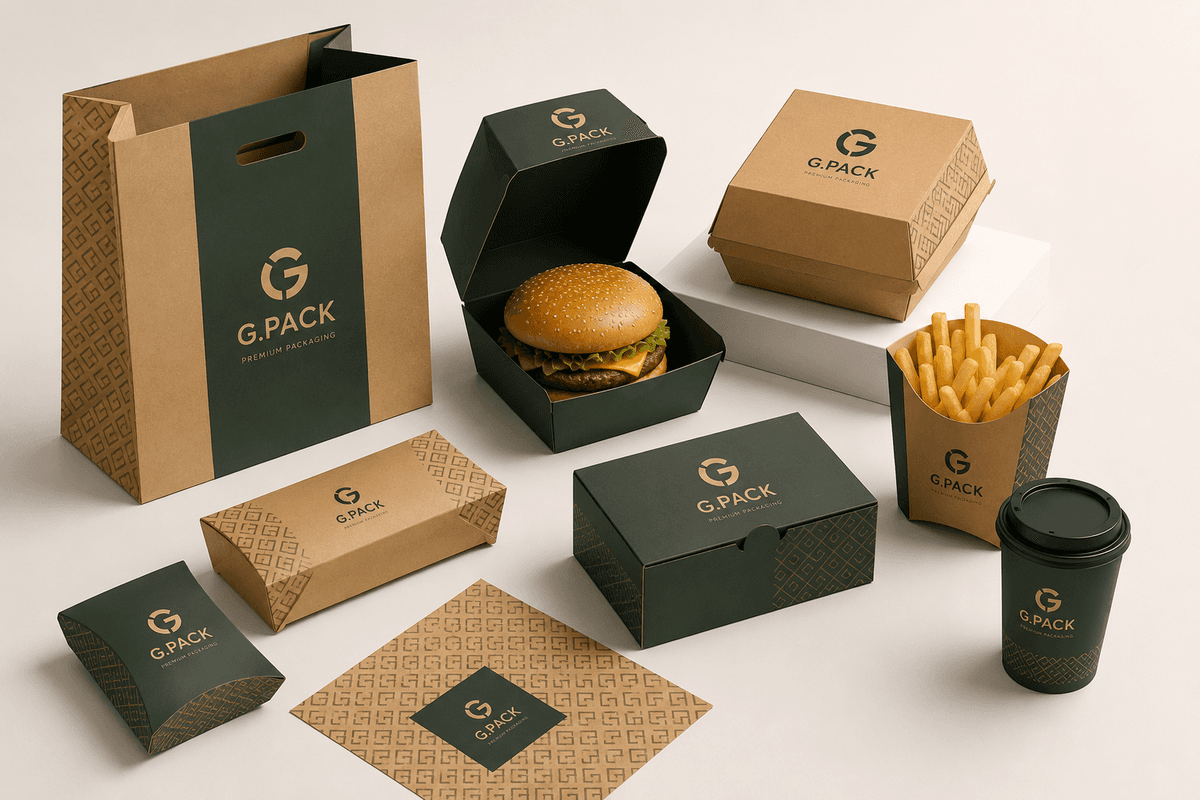
G-Pack supplies custom fries boxes in all formats: sleeves, trays, flap-lid delivery boxes, and compartment designs. PE inner lining and vent holes available on all formats. Minimum 1,000 units. Free samples before volume order.
Get a Free Quote